
Maharashtra & Gujarat Land Records: State Verification Gateway
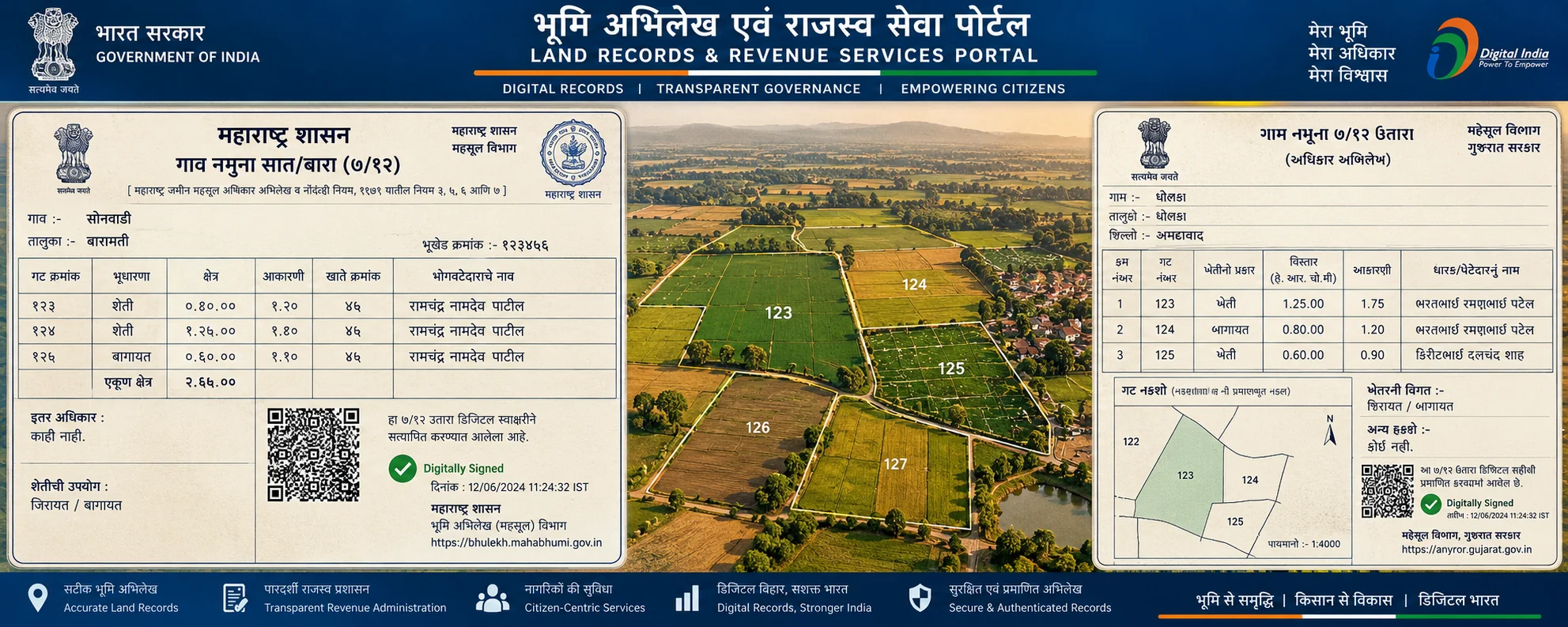
A digital 7/12 extract is an electronic Record of Rights maintained under state land revenue codes in Maharashtra and Gujarat. It documents land parcel ownership, cultivable acreage, survey numbers, and financial encumbrances. While uncertified copies on Mahabhulekh are for information only, extracts bearing cryptographic digital signatures from DigitalSatbara or e-Dhara possess full evidentiary standing in judicial and banking proceedings.
Statutory Land Record Fact Sheet: Digital 7/12
| Regulatory Dimension | Maharashtra Revenue Framework | Gujarat Revenue Framework |
|---|---|---|
| Controlling Authority | Revenue and Forest Department (भूमी अभिलेख) | Revenue Department, Gandhinagar (મહેસૂલ વિભાગ) |
| Governing Legislation | Maharashtra Land Revenue Code, 1966 (Sec 148-155) | Gujarat Land Revenue Code, 1879 (Sec 135A-135L) |
| Free Inspection Portal | Mahabhulekh | AnyRoR Rural & Urban Property Cards |
| Certified Issuance Portal | DigitalSatbara | e-Dhara Kendra / AnyRoR Certified Portal |
| Statutory Issuance Fee | Rs 15 per certified digitally signed extract | Rs 5 (e-Dhara center uncertified) / Rs 15 certified |
| Land Identifier Format | Survey Number / Gat Number + 14-digit ULPIN | Survey Number / Re-survey Number + ULPIN |
| Evidentiary Legal Admissibility | Admissible under IT Act 2000 Sec 1(3) & BSA 2023 | Admissible under IT Act 2000 & Evidence Rules |
Maharashtra Revenue Gateway
Access Mahabhulekh uncertified viewing, DigitalSatbara certified downloads, e-Hakk online mutations, and MahaBhunaksha cadastral maps.
Access Maharashtra GuideGujarat AnyRoR Gateway
Inspect Gujarat Village Forms 7, 12, 8A, e-Dhara mutation entries (Form 6), Old vs New Tenure restrictions, and rural cadastral parcel maps.
Access Gujarat Guide1. Statutory Structure of 7/12 Land Records (The Revenue Triad)
A standard 7/12 extract combines two distinct statutory village registers under the Maharashtra Land Revenue Manual. In Maharashtra, these registers are consolidated into a single document, whereas in Gujarat, they operate as distinct electronic databases.
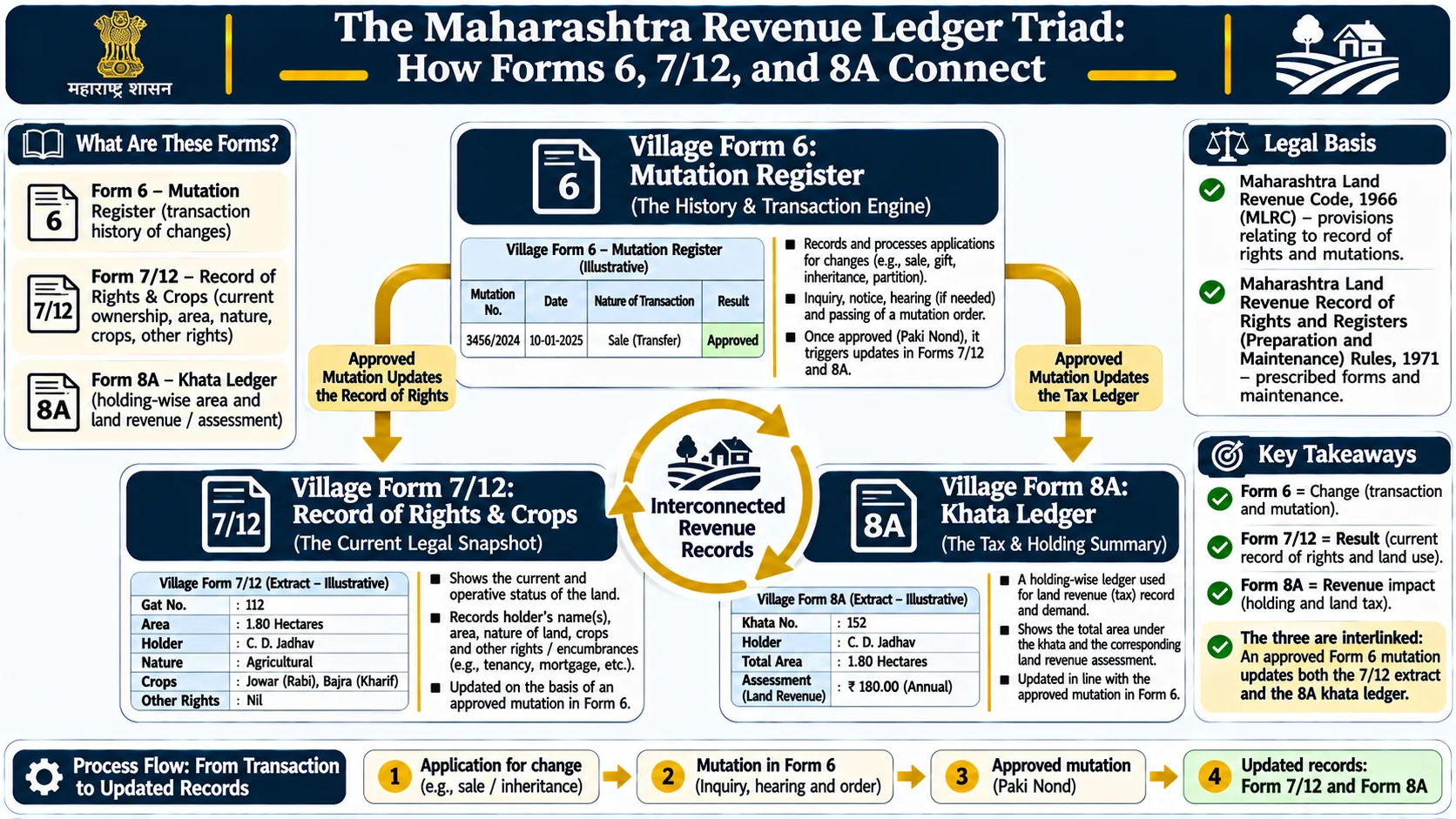
To evaluate land rights accurately, citizens and legal counsel must examine three interconnected documents:
- Village Form VII (सात - अधिकार अभिलेख): The upper section of the extract. It records the survey or gat number, sub-division (hissa), total land area in Hectare-Are, occupancy tenure classification (Bhogvatdar Class 1 or Class 2), registered Khatedar names, and local land assessment taxes.
- Village Form XII (बारा - पिकांची नोंदवही): The lower section of the extract. It details seasonal agricultural cultivation, crops sown during Kharif and Rabi seasons, irrigated versus non-irrigated acreage, commercial fruit tree counts, and uncultivable fallow areas.
- Village Form 8A (८-अ - खातावही): The landholder account register. While Form 7/12 relates to a specific physical land parcel, Form 8A aggregates all parcels owned by a single individual or family within that revenue village, calculating combined revenue liability.
The Other Rights column (इतर हक्क) on Village Form VII records third-party encumbrances, bank loan mortgages (Boja), statutory charges, and civil court injunctions.
2. Certified Digital Extracts vs Free Public Viewing
State revenue departments maintain two distinct electronic portals: one for open public inspection and one for official, certified legal issuance. Using the wrong format in legal or financial transactions leads to immediate document rejection.
| Feature | Free Viewing Extract (Mahabhulekh) | Digitally Signed Extract (DigitalSatbara) |
|---|---|---|
| Portal Endpoint | Mahabhulekh Portal | DigitalSatbara Portal |
| Cost & Login | Free; no citizen login required | Rs 15 per extract; mobile OTP login |
| Watermark | Watermarked: "फक्त माहितीसाठी" (For Information Only) | Clear official layout without watermarks |
| Security Markings | None; basic HTML render | 16-digit verification number, QR code, DSC hash |
| Court Admissibility | Inadmissible as primary evidence | Admissible under IT Act 2000 Section 1(3) |
| Bank Mortgage Sanction | Not accepted by lending institutions | Mandatory for loan processing and registration |
Under statutory circulars issued by the Maharashtra Revenue and Forest Department, digitally signed extracts generated from the DigitalSatbara portal do not require a physical rubber stamp or wet signature from the Village Talathi. Any government authority or bank demanding a manual signature on a certified digital extract acts contrary to official departmental directives.
3. Gujarat AnyRoR & e-Dhara System: Village Form Unbundling
A frequent error made by citizens and legal practitioners familiar with Maharashtra is searching for a single combined 7/12 extract on Gujarat revenue portals. In Gujarat, the revenue framework unbundled these records into separate digital databases.
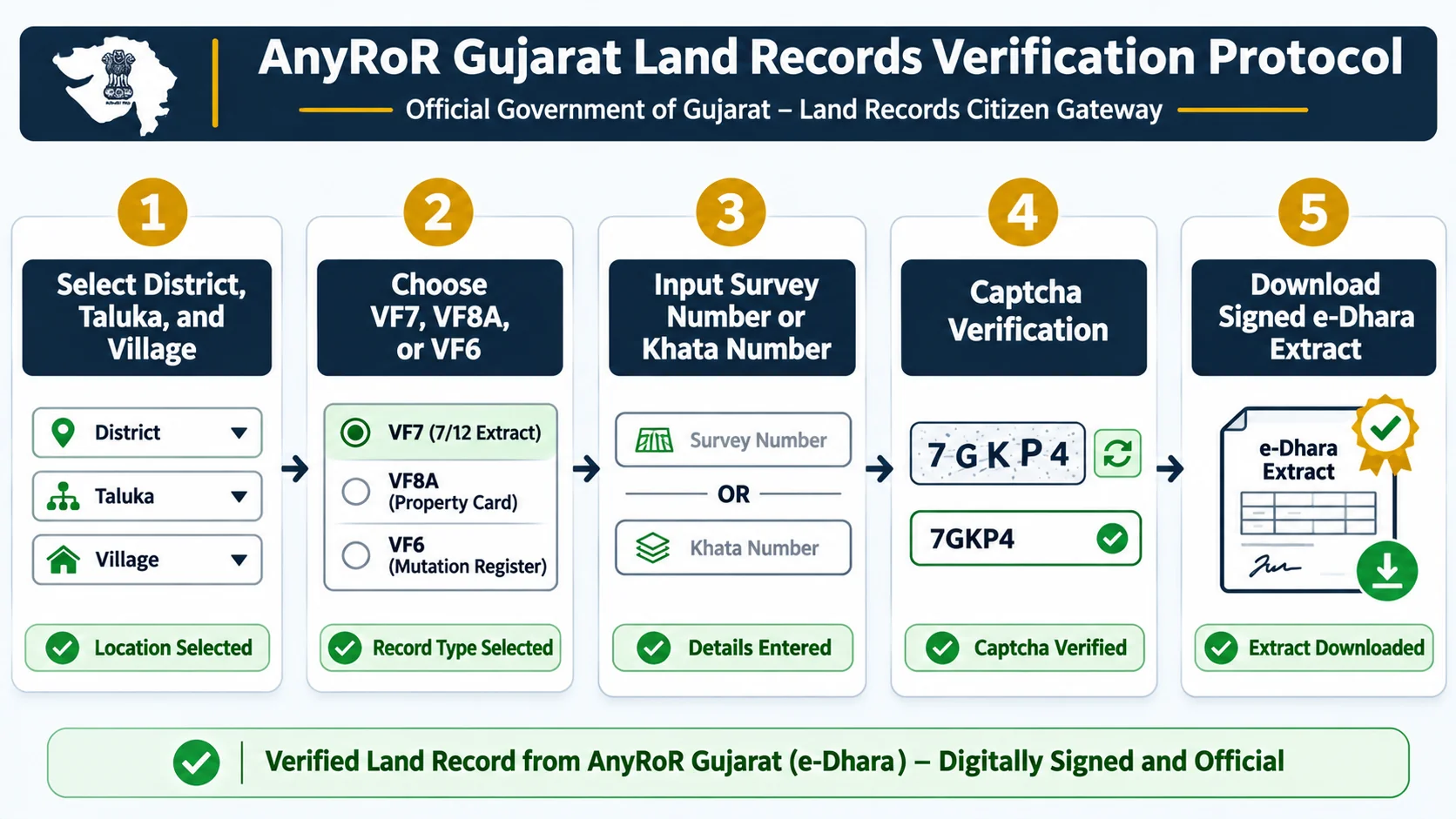
Under Gujarat Revenue Department Circular No. E-DHR-102011-2099-J, dated 16 March 2012, land records in Gujarat are inspected through the official AnyRoR (@ Anywhere) portal AnyRoR Portal under four distinct classifications:
- Village Form 7 (ગામ નમૂના નં. ૭ - અધિકાર પત્રક): Contains ownership details, Khata number, survey number, total area in Hectare-Are-SqM, tenure status, and encumbrances.
- Village Form 12 (ગામ નમૂના નં. ૧૨ - પાકની વિગત): Contains seasonal agricultural crop surveys, irrigated versus rain-fed land, and fallow classifications.
- Village Form 8A (ગામ નમૂના નં. ૮-અ - ખાતાવही): Summarizes all agricultural holdings belonging to a Khatedar across the revenue village.
- Village Form 6 (ગામ નમૂના નં. ૬ - હક્ક પત્રક): The statutory mutation register recording every transfer of ownership, succession, partition, and mortgage lien under Section 135D of the Gujarat Land Revenue Code, 1879.
In Gujarat, property buyers must also confirm tenure classification: Old Tenure (જૂની શરત) allows unrestricted commercial sale, whereas New & Restricted Tenure (નવી અને પ્રતિબંધિત શરત) requires prior written sanction from the District Collector and payment of state premium (Nazrana).
4. Mutation Process & Public Notice (Aapli Chawadi & e-Ferfar)
Executing a registered sale deed at the Sub-Registrar office does not automatically update the Record of Rights. The transaction must undergo the statutory mutation process (Ferfar / फेरफार) under Section 150 of the Maharashtra Land Revenue Code, 1966.
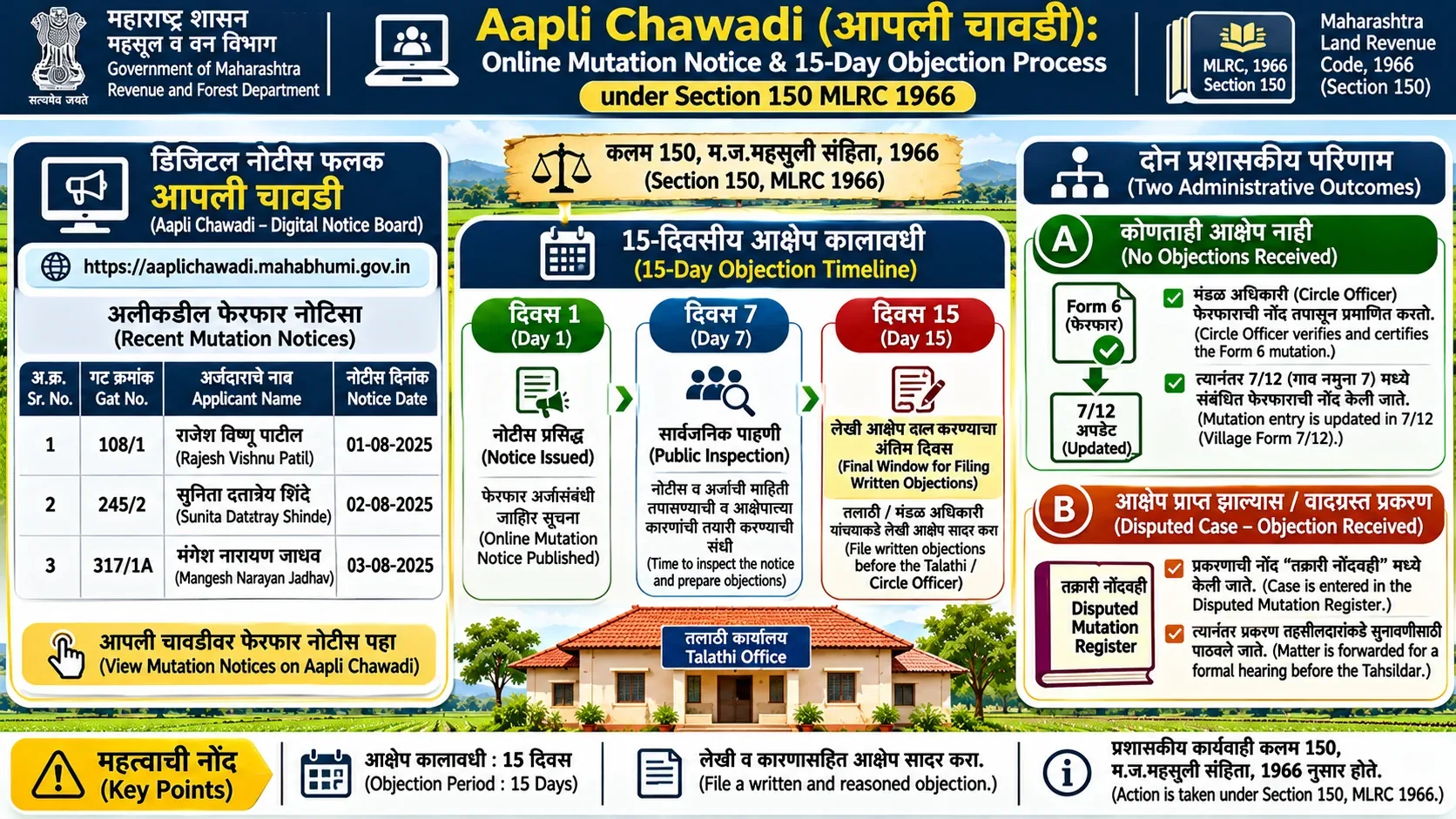
The mutation workflow follows four mandatory administrative stages:
- Provisional Entry (Pencil Entry / कच्ची नोंद): When a registered transaction or succession request is received, the Talathi enters a provisional mutation into the register. The Ferfar number appears in parentheses in the Other Rights column.
- Digital Notice Publication (Aapli Chawadi / आपली चावडी): Under Section 150(2), the Talathi publishes the mutation notice digitally on the Aapli Chawadi portal Aapli Chawadi notice board and issues physical notices to interested parties.
- 15-Day Statutory Objection Window: Any co-owner, legal heir, or creditor with a lawful objection must submit a written dispute to the Talathi within 15 days of notice publication.
- Certification by Circle Officer (मंजूर फेरफार): If no valid objections are lodged, the Circle Officer (Mandal Adhikari) certifies the mutation. The Talathi permanently updates the 7/12 extract, removing the pencil notation.
If a dispute is raised, the case transfers to the contested mutation register (विवादित फेरफार नोंदवही), requiring formal adjudication by the Tehsildar under Section 247 appellate proceedings.
5. Pre-Purchase Legal Due Diligence & Title Verification
Under settled Supreme Court jurisprudence, revenue records do not confer or guarantee title to property. In landmark rulings including Suraj Bhan v. Financial Commissioner (2007) 6 SCC 186 and Bhimabai Mahadeo Kambekar v. Arthur Import & Export Co. (2019) 3 SCC 191, the Apex Court affirmed that a 7/12 extract is purely a fiscal document for tax assessment purposes.
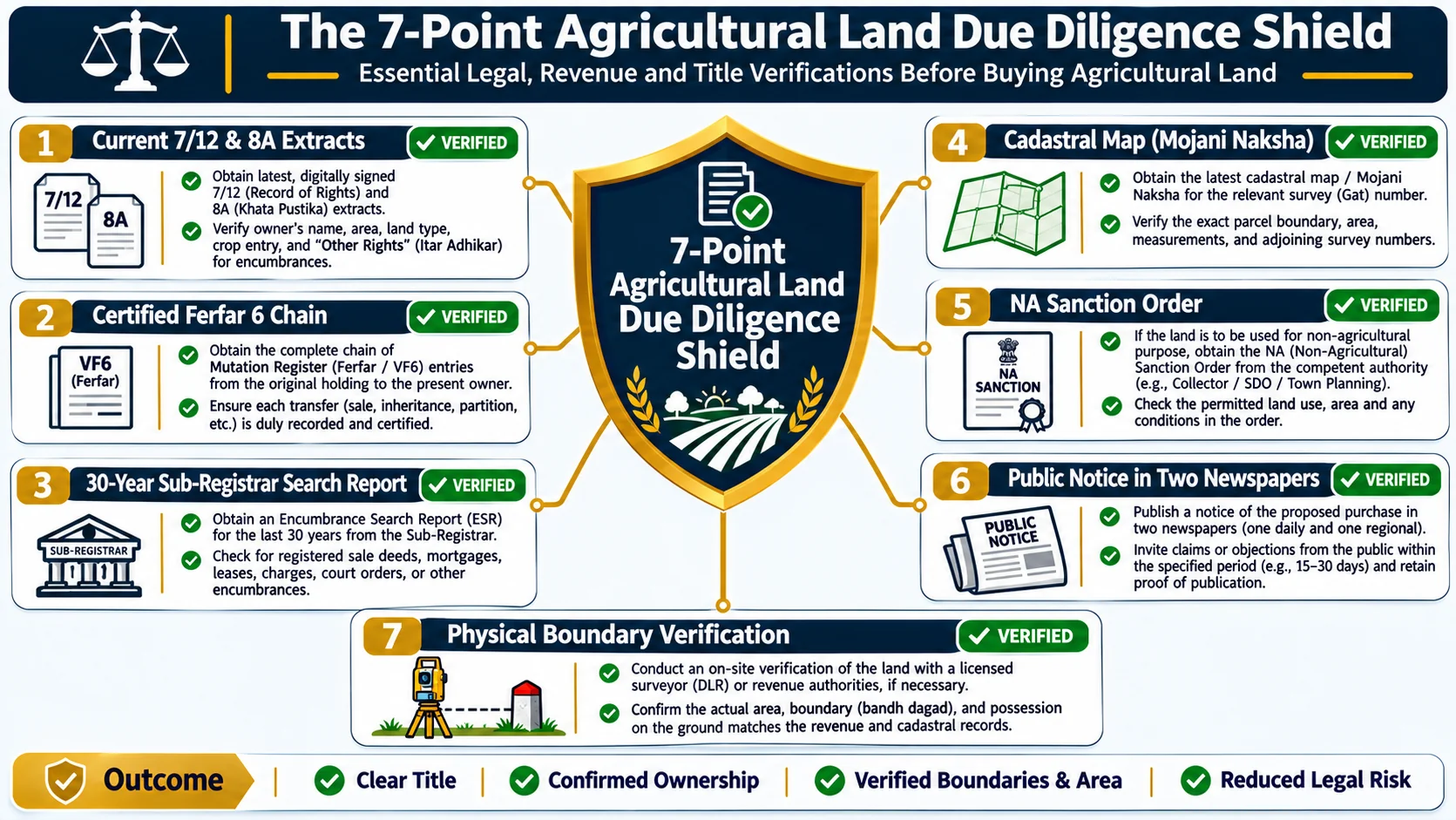
Prior to executing an agreement for sale or disbursing financial consideration, property buyers must execute a rigorous 7-point due diligence protocol:
- Verify 30-Year Chain of Title: Order certified copies of all historical Ferfar mutation entries spanning 30 years to trace lawful inheritance, registered conveyances, and past partitions.
- Inspect Other Rights for Bank Boja: Confirm that all prior bank loans, cooperative society charges, and government attachments are formally discharged via certified mutation entries.
- Audit All Recorded Co-Holders: Ensure every registered Khatedar, including female coparceners under the Hindu Succession Act, executes the conveyance deed.
- Examine Tenure Class: Confirm the land is Bhogvatdar Class 1. If Class 2, demand certified copies of District Collector sanction orders.
- Check for Section 36A Tribal Land Restrictions: Verify that the land does not belong to a member of a Scheduled Tribe, which strictly prohibits transfer to non-tribal buyers under MLRC Section 36A.
- Verify Potkharaba Area Deductions: Confirm how much total acreage is deducted as uncultivable terrain (Class A) or reserved for public easements (Class B).
- Commission Official Mojani Boundary Survey: Verify physical fence boundaries through an official demarcation survey conducted by the Deputy Superintendent of Land Records (DYSLR).
6. Cadastral Boundaries, GIS Maps & ULPIN Bhu-Aadhaar
Land record governance in India now integrates textual revenue registers with geo-referenced spatial cadastral surveys. In Maharashtra and Gujarat, land records are integrated with GIS cadastral village maps.
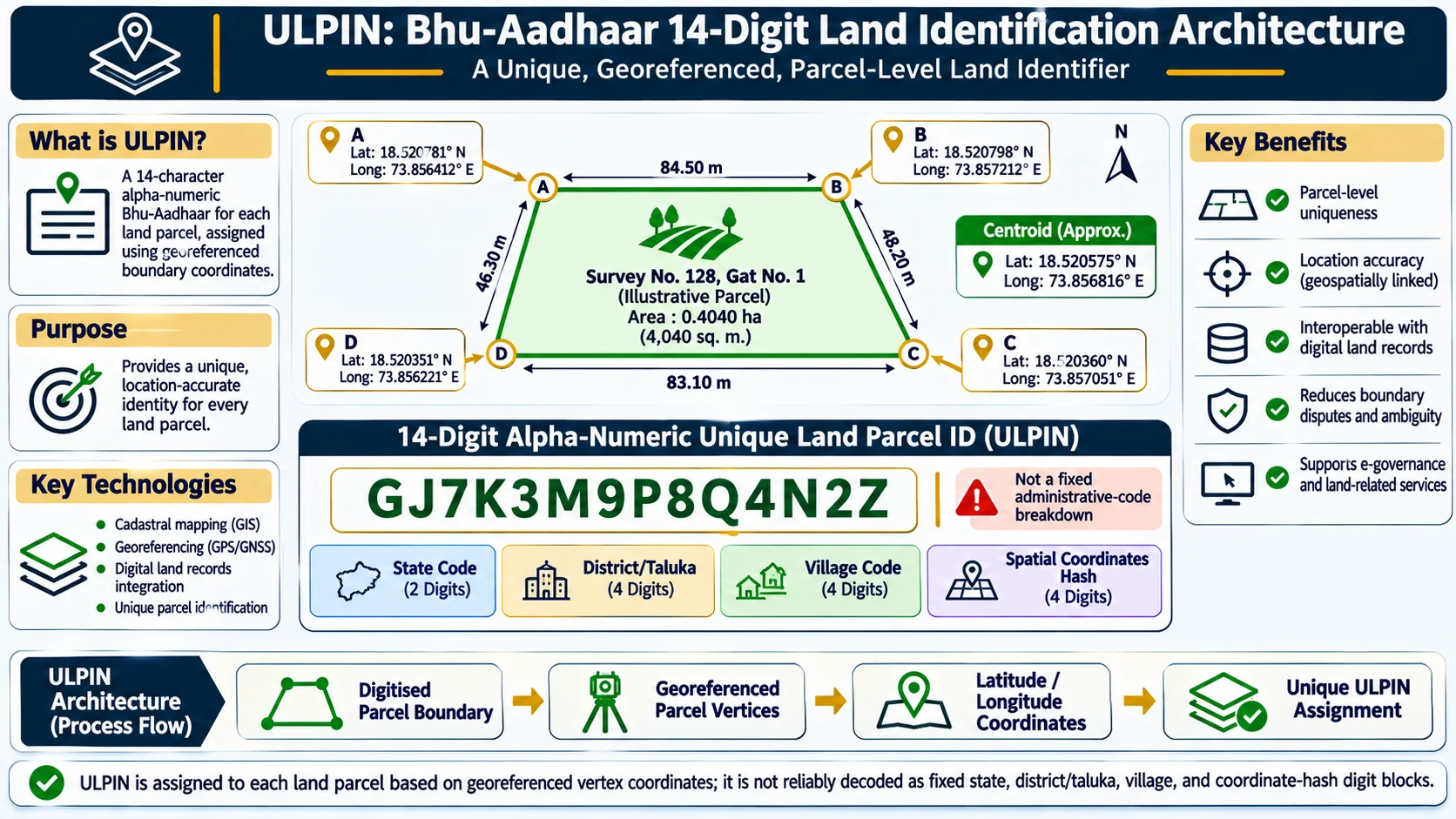
Key technological standards governing cadastral land records include:
- Unique Land Parcel Identification Number (ULPIN / भू-आधार): A 14-digit alphanumeric code assigned to every surveyed agricultural plot based on the international standard of geographical longitude and latitude coordinates of the parcel vertices. It eliminates duplicate numbering across revenue boundaries.
- MahaBhunaksha Portal: The official web GIS platform where citizens can view, overlay, and download village cadastral maps (गाव नकाशा) and individual plot reports (प्लॉट रिपोर्ट) showing exact boundary dimensions.
- 7/12 vs Urban Property Card Boundary: While agricultural lands are recorded in Village Form 7/12 under MLRC Section 148, lands within municipal corporation limits or surveyed gaothan settlements transition to the City Survey Property Card (मालमत्ता पत्रक / CTS Card) under MLRC Section 126.
When purchasing urban apartments or residential plots in cities such as Mumbai, Pune, Nagpur, or Thane, buyers must inspect the CTS Property Card rather than a rural 7/12 extract.
7. Frequently Asked Questions (Statutory & Evidentiary)
What information does a certified 7/12 extract contain?
A certified 7/12 extract contains Village Form VII (survey number, Gat number, sub-division hissa, total area in Hectare-Are, land tenure class, landholder names, and revenue assessment) and Village Form XII (seasonal crops, irrigated versus rain-fed acreage, tree counts, and fallow classifications). The Other Rights column records bank mortgages, government recovery liens, and pending mutation notices.
What is the difference between a 7/12 extract and Form 8A?
A 7/12 extract pertains to a specific physical land parcel (Survey or Gat number), detailing its legal tenure, area, and cultivation. Form 8A (खातावही) is a consolidated ledger of a specific landholder's total holdings across all parcels owned within that revenue village, used to determine total cumulative agricultural land tax liability.
How is a digitally signed Maharashtra 7/12 verified?
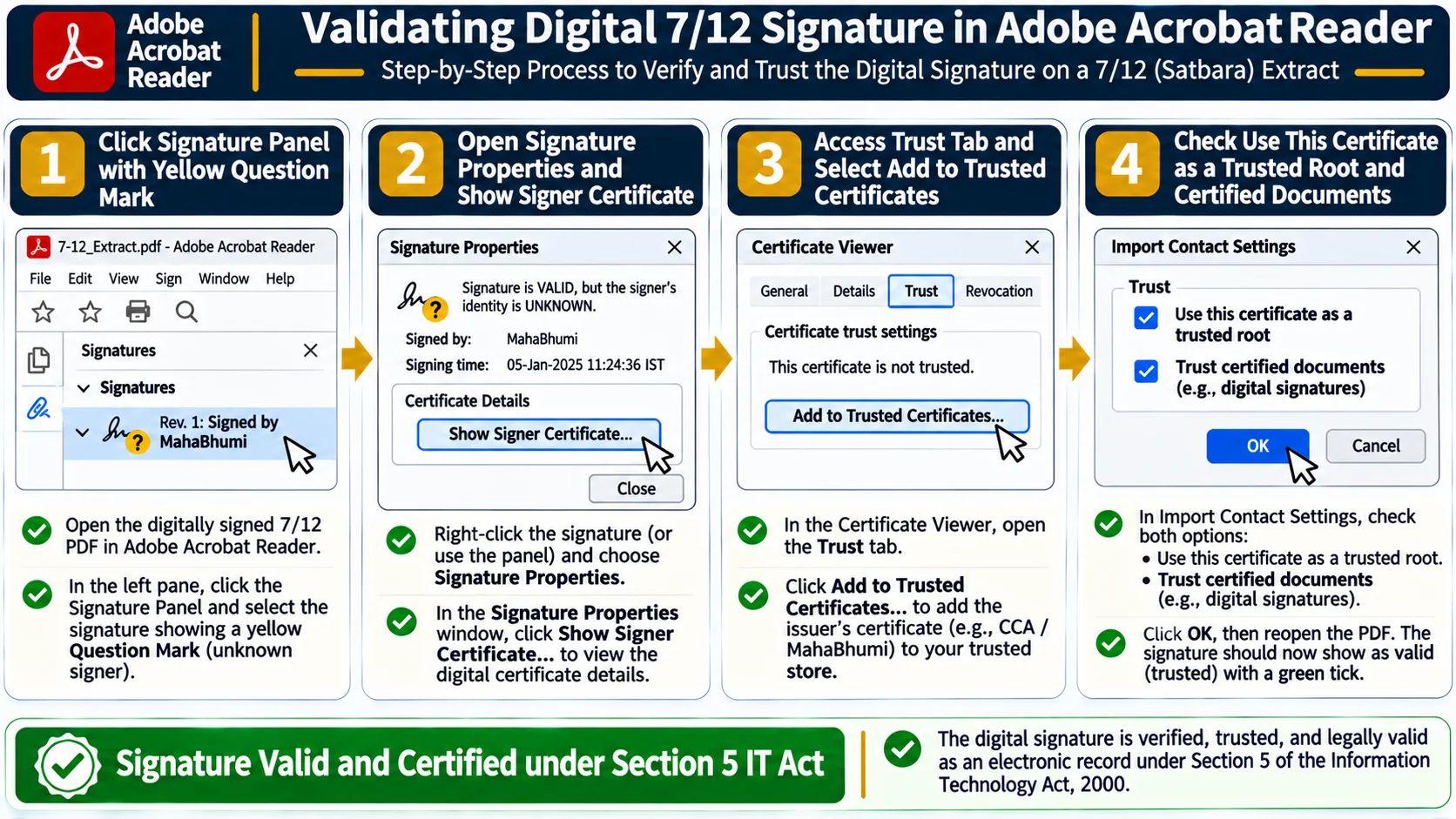
A digitally signed 7/12 extract downloaded from DigitalSatbara carries a 16-digit verification code and a secure QR code. To verify authenticity, access the DigitalSatbara Portal, select the Verify 7/12 service, enter the 16-digit number, or scan the QR code using the MahaBhumi mobile application to compare the cryptographic hash against the state database.
Does a 7/12 extract prove absolute ownership of the land?
No. Under the Supreme Court ruling in Suraj Bhan v. Financial Commissioner (2007), a 7/12 extract is purely a fiscal document for tax assessment purposes. It creates a rebuttable presumption of possession, not conclusive ownership. True legal title requires a registered conveyance deed (Sale Deed, Gift Deed, Partition Deed) registered with the Sub-Registrar under the Registration Act, 1908.
How do Gujarat's Village Forms 7, 12, and 8A differ from Maharashtra?
In Maharashtra, Form 7 and Form 12 are consolidated into a single combined extract. In Gujarat, under Revenue Department Circulars issued in 2012, Village Form 7 (Record of Rights and Tenure) and Village Form 12 (Register of Crops) were separated into independent electronic records on AnyRoR. Citizens inspect VF-7 for ownership and VF-12 for seasonal crop surveys separately.
What should a landowner do if a name or area appears incorrect on the 7/12?
Minor clerical or typographical errors are corrected by filing an application under Section 155 of the Maharashtra Land Revenue Code, 1966, before the Tehsildar or Sub-Divisional Officer (SDO). Substantive disputes over inheritance, shares, or boundaries require formal mutation appeals under Section 247 of the MLRC or adjudication before a competent civil court.
8. State Revenue Helplines & Departmental Portals
For official transaction processing, certified document issuance, and citizen grievance escalation, reference the verified state department endpoints below:
- Maharashtra Mahabhulekh (Free View): Mahabhulekh Portal
- Maharashtra DigitalSatbara (Certified PDF): DigitalSatbara Portal
- Maharashtra e-Hakk Online Mutation: e-Hakk Online Mutation Gateway
- MahaBhunaksha Cadastral Maps: MahaBhunaksha Portal
- Gujarat AnyRoR Official Portal: AnyRoR Gujarat Portal
- National DILRMP Portal: National DILRMP Portal
- Central Helpline Contact (Pune Directorate): 020-25712712 / 020-26050006