
Land Purchase Due Diligence: A Practical Checklist for Buyers

Do not pay substantial advances or execute agreements based solely on a 7/12 or Property Card. Buyers must verify registered title deeds, mutation lineage, encumbrance clearances, tenure restrictions (Class I vs Class II under MLRC Section 29), and physical cadastral boundaries on MahaBhunaksha. Revenue records track fiscal occupancy; substantive title requires deed examination by practicing legal counsel.
Administrative Dimension Fact Sheet: At a Glance
| Administrative Dimension | Statutory Specification & Governance |
|---|---|
| Governing Legislation | Transfer of Property Act, 1882 (Sections 54 & 55) and Maharashtra Land Revenue Code, 1966. |
| Judicial Precedent | Suraj Bhan v. Financial Commissioner (Supreme Court): Revenue entries serve fiscal purposes and do not confer title. |
| Tenure Restrictions | Occupant Class II (MLRC Section 29) requires Collector sanction and premium (nazrana). Reference 4 March 2025 conversion rules. |
| Search Scope | Determined by property counsel based on tenure origin and registered deed chain (not a uniform statutory 30-year command). |
| Primary Revenue Records | Digitally signed Village Form 7/12 (Rural) or CTS Property Card (Urban), plus Village Form 6 Ferfar mutation register. |
| Boundary Verification | Cadastral GIS map inspection via MahaBhunaksha; physical boundary confirmation through Land Records Department measurement (Mojani). |
Acquiring agricultural, residential, or commercial land demands exhaustive legal investigation beyond inspecting an isolated 7/12 extract or Property Card. Necessary statutory clearances, conveyance instruments, and revenue validations depend on tenure classification, administrative zoning, and applicable state land enactments. This checklist provides a structured protocol for prospective purchasers to conduct preliminary title verification alongside independent property counsel.
1. Identify the Exact Property and Administrative Jurisdiction
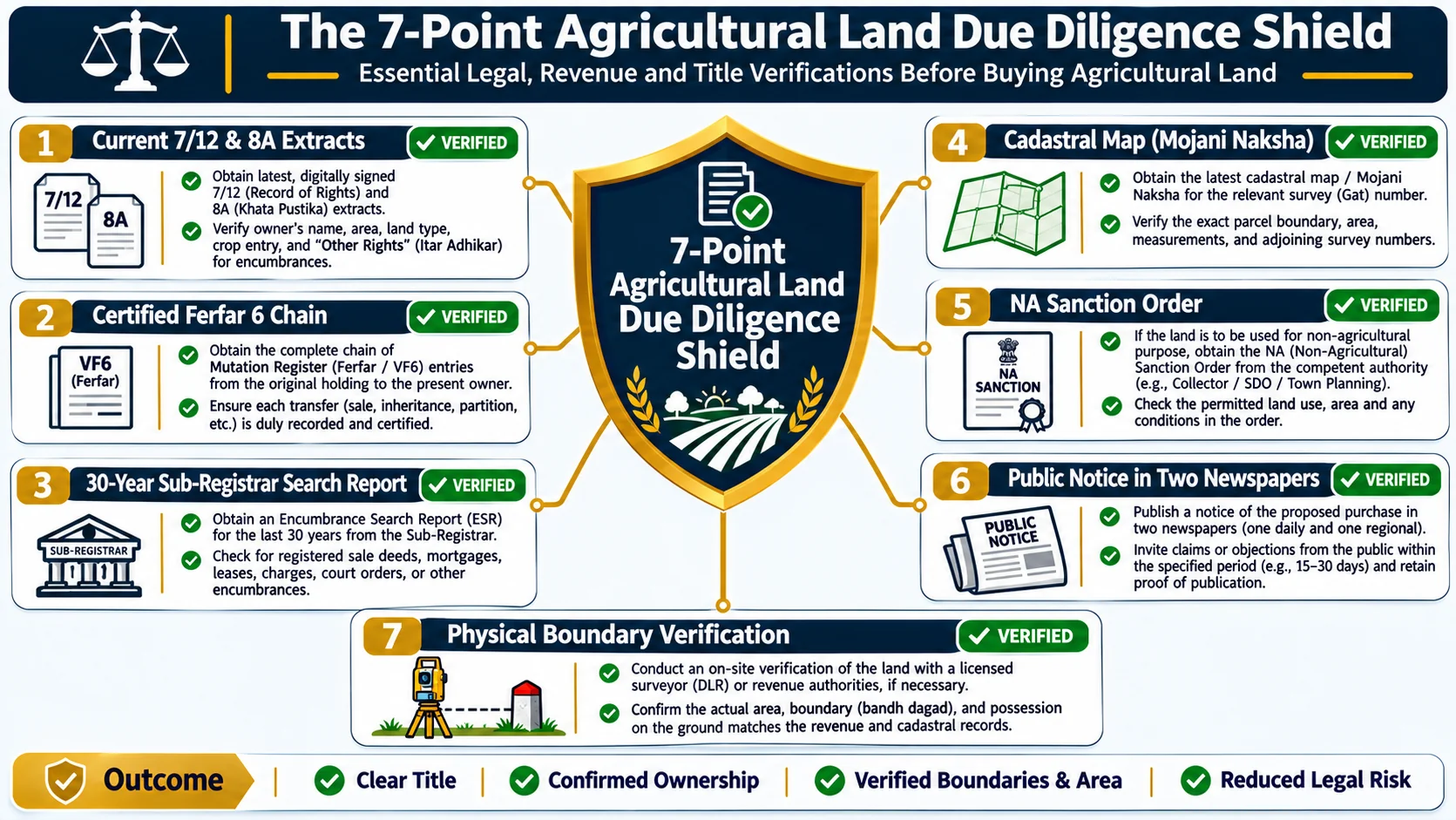
Ascertain cadastral location identifiers across revenue and municipal registers:
- Obtain the complete revenue hierarchy: District, Taluka, Revenue Village, Ward, or City Survey Office.
- Record the Survey/Gat number, Hissa/subdivision, or CTS/Property Card number.
- Obtain the official cadastral or city survey map and compare parcel identifiers with the transaction documents.
- Confirm recorded land area, measurement units (Hectares, Ares, Gunthas, Square Metres), and stated boundaries.
2. Obtain Current and Historical Land Records
Procure certified, digitally signed extracts from designated government portals:
- Maharashtra Rural Land: Current digitally signed 7/12, 8A (holding extract), and relevant Village Form 6 (Ferfar) mutation entries.
- Maharashtra Urban Land: Current CTS Property Card (Malmatta Patrak) and city survey mutation records.
- Gujarat Rural Land: Relevant AnyRoR Village Forms (VF-7, VF-12, VF-8A, VF-6) and e-Dhara records.
- Gujarat Urban Property: e-Milkat Property Card and urban survey registers.
Verify that revenue extracts correspond strictly to the physical parcel conveyed. Phonetic similarities in village names or adjacent survey boundaries do not constitute legal identity.
3. Review the Registered Title Deeds
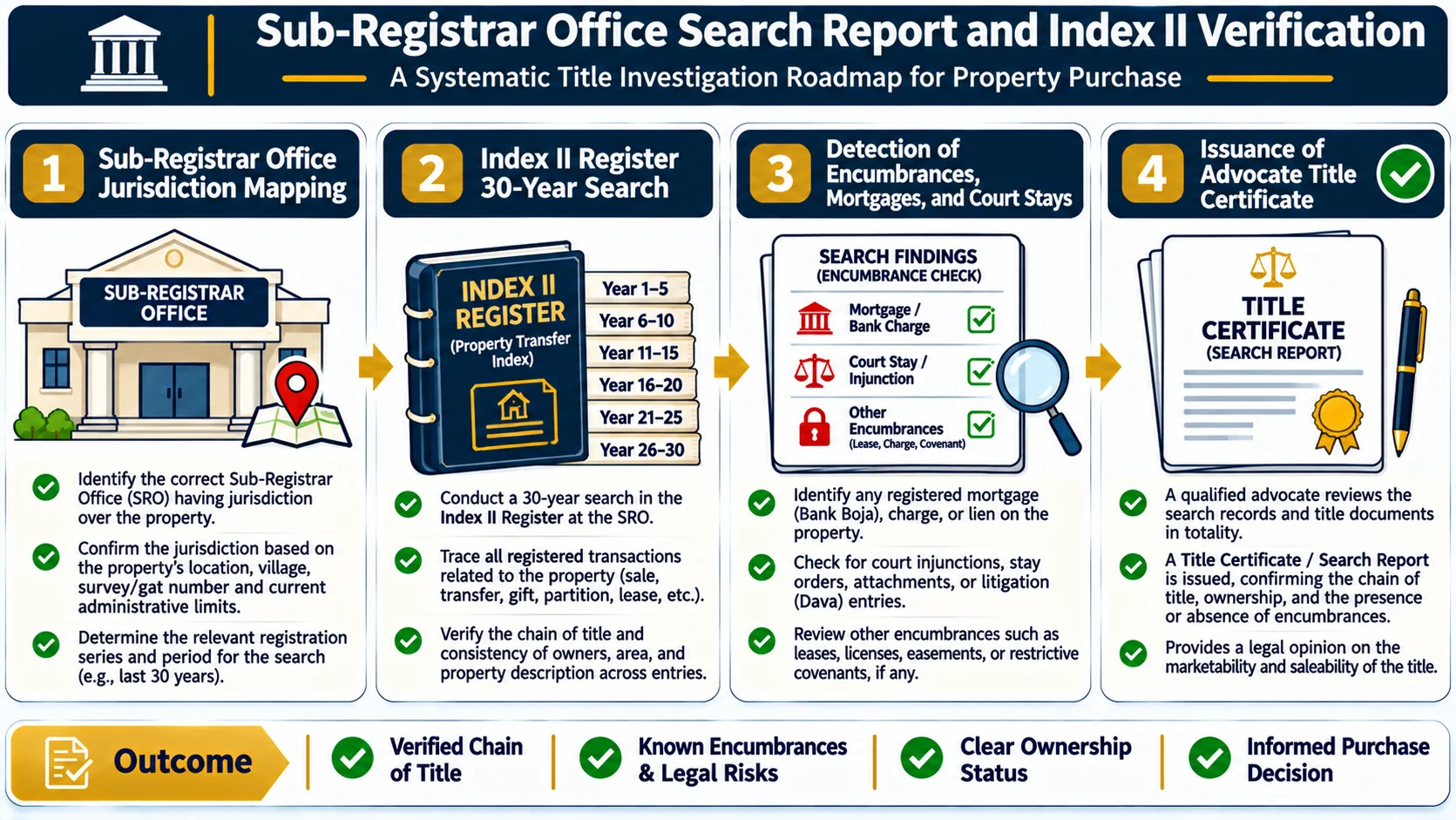
Retain property legal counsel to investigate the unbroken 30-year chain of registered title instruments establishing the transferor's proprietary root of title. This examination encompasses registered sale deeds, partition deeds (Vatap-Patra), gift deeds, testamentary probate grants, final court decrees, and government sanads.
4. Check Mutation Entries and Track Succession Linage
Scrutinize mutation (Village Form 6 Ferfar) entries establishing how the transferor's interest was entered into the Record of Rights:
- Read the underlying orders and supporting documents; do not rely solely on a mutation reference number.
- Check whether mutation entries are pending, disputed, subject to objection notices (such as Section 135D notices in Gujarat or Section 150 notices in Maharashtra), or certified.
- Verify succession lineage, family pedigree, and partition documents where property was inherited.
The Supreme Court in Suraj Bhan v. Financial Commissioner (2007) observed that revenue entries serve a fiscal purpose and do not confer substantive ownership. Substantive disputes must be resolved through a competent civil court.
5. Investigate Loans, Charges, and Encumbrances
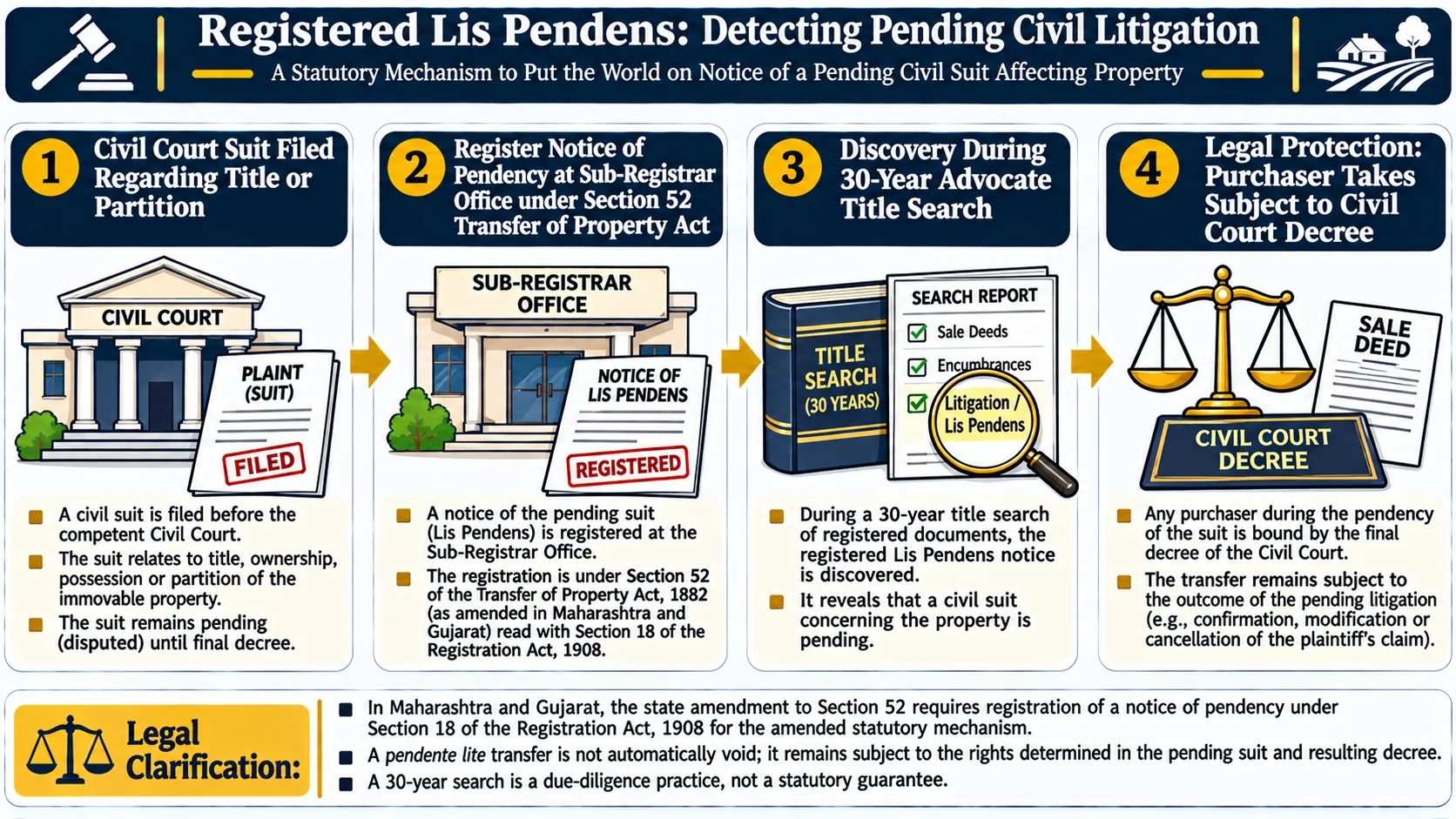
Verify freedom from encumbrances, charges, and judicial attachments:
- Ask the seller to disclose all mortgages, bank loans, cooperative credit hypothecations, charges, liens, and attachment orders.
- Where a loan has been repaid, demand the bank's written repayment certificate and verify that the Boja has been formally removed via e-Hakk (see our Boja Removal Guide).
- Inspect the Other Rights (इतर हक्क) column, but note that registered charges outside the revenue extract may also exist; review Sub-Registrar encumbrance records.
6. Check Tenure, Land-Use, and Transfer Restrictions
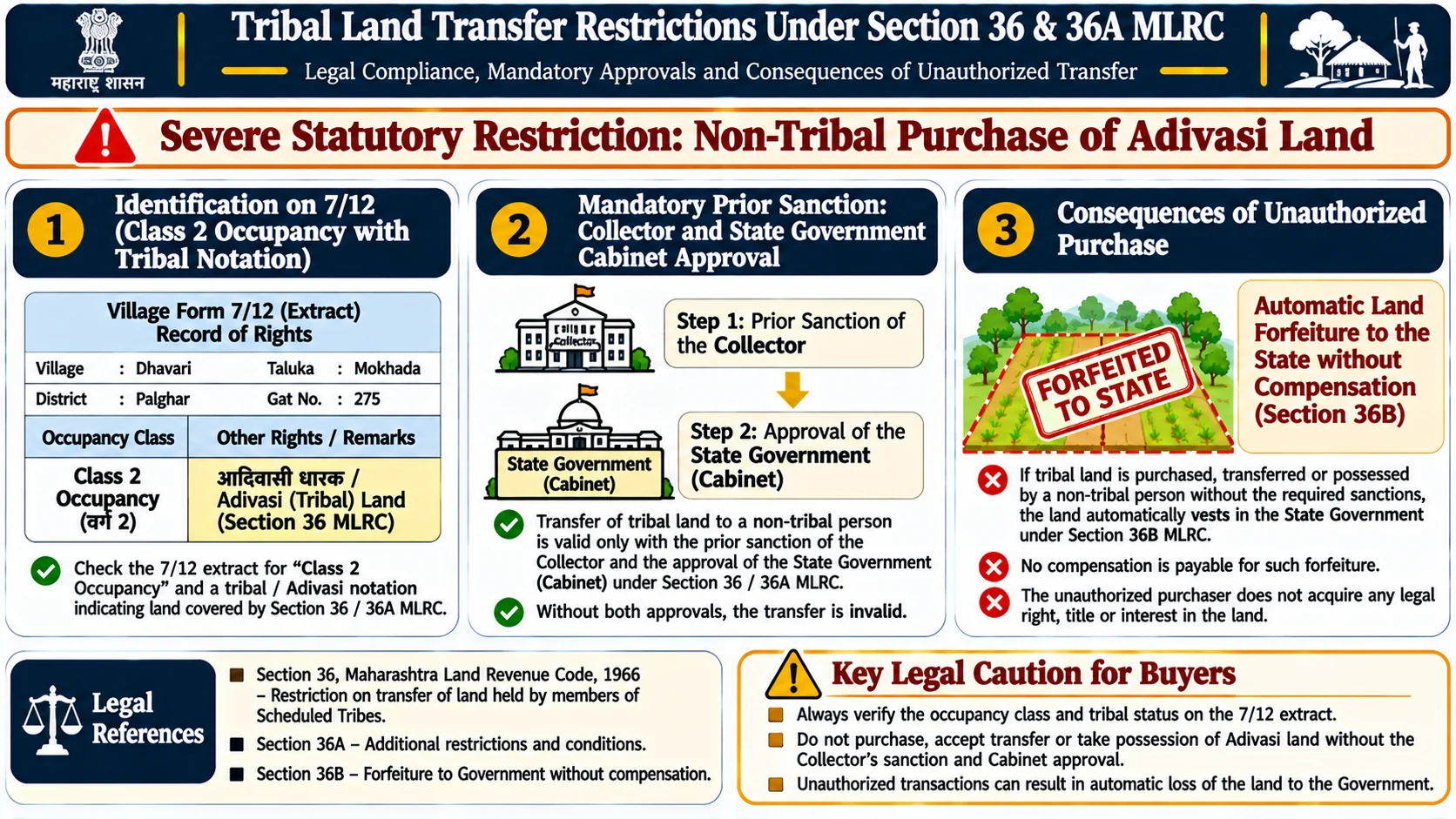
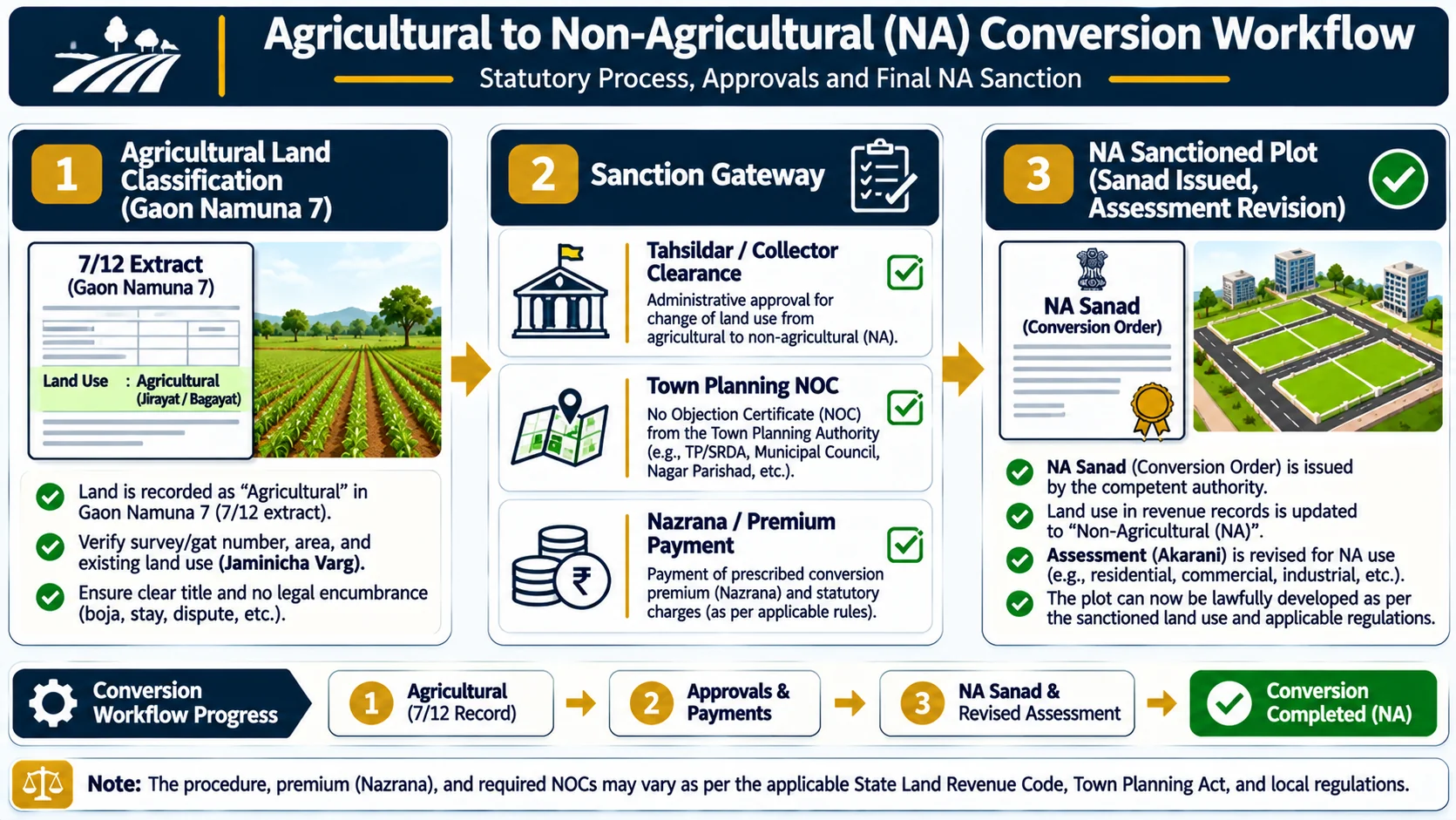
Tenure classification determines whether land can be lawfully alienated:
- Occupant Class I (भोगवटदार वर्ग-१): Unrestricted tenure; freely alienable without Collector sanction.
- Occupant Class II (भोगवटदार वर्ग-२): Restricted tenure (government grants, tenant purchases, vatan lands). Sale requires prior written permission from the District Collector and payment of government premium (nazrana) under Section 29 of the MLRC, 1966. Reference the Maharashtra Government conversion rules published on 4 March 2025 for eligible conversions to Class I.
- Agricultural Transfer Bars: Verify purchaser eligibility under applicable state laws (such as Section 63 of the Gujarat Tenancy and Agricultural Lands Act, 1948 or Maharashtra tenancy provisions).
- Tribal Land Protections: Transfers involving tribal landholders are subject to strict statutory bars under Section 36/36A of the MLRC and equivalent state statutes.
7. Verify Boundaries, Physical Condition, and Ground Access
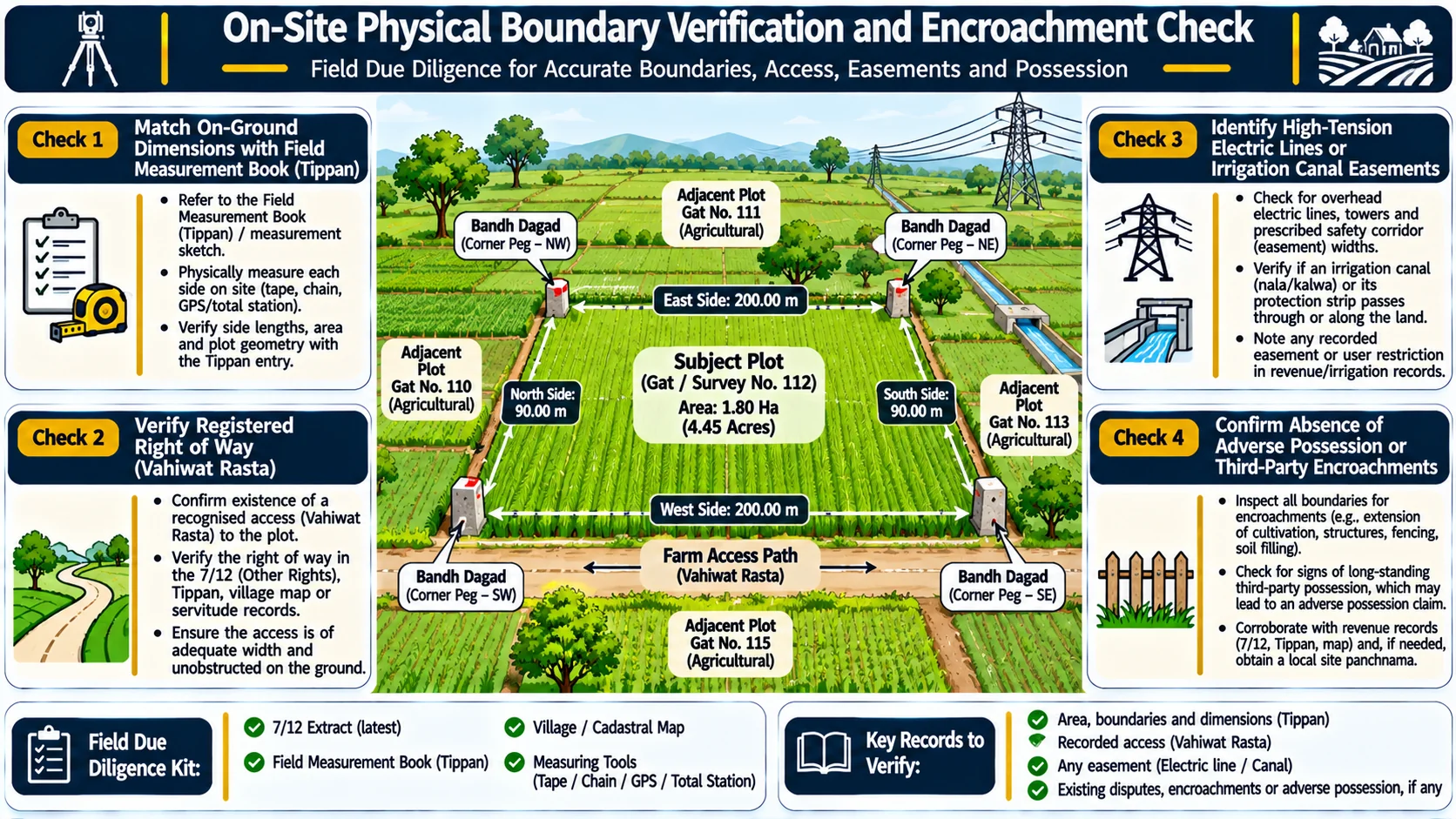
Conduct physical on-site inspection and cadastral boundary demarcation:
- Visit the parcel in the presence of the seller and adjoining landholders.
- Compare visible ground boundaries with the official cadastral map (see MahaBhunaksha Guide).
- Verify access roads. A cart track or path on a map does not automatically establish an unencumbered legal right of way.
- Check for physical encroachments, high-tension electrical lines, public watercourses, or unauthorized occupants.
- If boundary or acreage discrepancies exist, apply for official land measurement (Mojani) through the Land Records Department.
8. Check Planning, Zoning, and Acquisition Notices

Verify statutory reservations, master plan zoning, and acquisition notices:
- Check regional development plans, zoning classifications, and permitted land use with local planning authorities (e.g., MMRDA, PMRDA, AUDA).
- Confirm whether any government acquisition notices, road-widening reservations, irrigation channels, or forest buffer zones affect the survey number.
- For non-agricultural (NA) land, verify the official NA conversion order and sanctioned layout plan.
9. Verify Seller Identity and Authority to Convey
Verify transferor legal capacity, identity, and statutory authority to convey:
- Verify seller identity against registered deeds and official government photo IDs.
- If the transaction involves a Power of Attorney (PoA), verify its validity, registration status, specific conveying powers, and confirm the principal is alive.
- For jointly held or ancestral property, ensure all co-owners, coparceners, and legal heirs execute or consent to the deed.
- For corporate entities, verify board resolutions, articles of association, and statutory authority.
10. Document Terms and Payment Conditions Before Advance
Safeguard earnest money deposits and consideration payments:
- Retain copies of all inspected records with dates and issuing authorities.
- Make transaction agreements conditional upon satisfactory resolution of identified legal or encumbrance discrepancies.
- Use traceable electronic payment channels and record consideration schedules clearly in the formal agreement.
- Avoid verbal representations regarding pending record corrections, dispute clearances, or road access.
Documents to Discuss with Your Property Lawyer
| Document / Record | Legal Purpose & Relevance |
|---|---|
| Current 7/12, 8A or Property Card | Identifies current revenue/city-survey records, recorded area, and fiscal tenure. |
| Mutation / Ferfar History | Explains recorded changes of ownership and underlying succession or conveyance orders. |
| Registered Title Deeds | Traces root of title and chain of conveyances across prior owners. |
| Lender Release / Discharge Letter | Confirms that recorded bank mortgages or hypothecations have been fully settled. |
| Cadastral Map & Mojani Plan | Compares mapped parcel geometry and resolves boundary, road, or area discrepancies. |
| Tenure / NA Sanction Orders | Establishes lawful land use and compliance with Occupant Class II or conversion conditions. |
| Planning & Non-Acquisition Certificates | Confirms absence of public reservations, road widening, or eminent domain proceedings. |
Statutory Framework & Judicial References
- Transfer of Property Act, 1882: Section 54 (sale defined, requirement of registered instrument) and Section 55 (rights and liabilities of buyer and seller, seller's disclosure covenants).
- Maharashtra Land Revenue Code, 1966: Section 29 (classes of occupants), Section 29A (conversion of occupancy), and Section 148-150 (Record of Rights and mutation procedures).
- Supreme Court of India: Suraj Bhan v. Financial Commissioner (2007): Settled doctrine establishing that entries in revenue records have a fiscal purpose and do not confer title.
- Official Conversion Rules: Maharashtra Government Notification dated 4 March 2025 regarding Occupancy Class II conversion terms.
Frequently Asked Questions
Is a 7/12 extract enough to buy agricultural land?
No. A 7/12 extract is a fiscal record for tax assessment and tracking agricultural occupancy. Under Supreme Court precedent (Suraj Bhan v. Financial Commissioner), revenue entries do not confer title. Buyers must review registered title instruments, mutation history, encumbrances, tenure restrictions, and boundary demarcation.
Must every land buyer conduct a 30-year title search?
There is no single statutory rule fixing an inflexible 30-year period for every transaction. The appropriate search period and scope depend on the parcel's title history, tenure origin, applicable state legislation, and professional advice from practicing property counsel.
Does a bank Boja entry mean a sale is automatically prohibited?
Do not assume a universal result. The legal effect depends on the underlying registered mortgage or security instrument, lender rights, and registration requirements. Obtain written lender release documentation and legal review before proceeding.
Does a cadastral map prove legal access to a public road?
No. A cadastral map may show geographic features, cart tracks, or boundaries, but legal right of way depends on recorded easements, public road declarations, and title grants. Verify physical and legal access on the ground.
Can the revenue office decide a substantive title dispute?
Revenue authorities maintain and update the Record of Rights within their statutory fiscal administrative role. Substantive disputes concerning legal ownership, deed validity, or partition must be adjudicated by a competent civil court.