
7/12 Extract vs Property Card in Maharashtra: What Is the Difference?
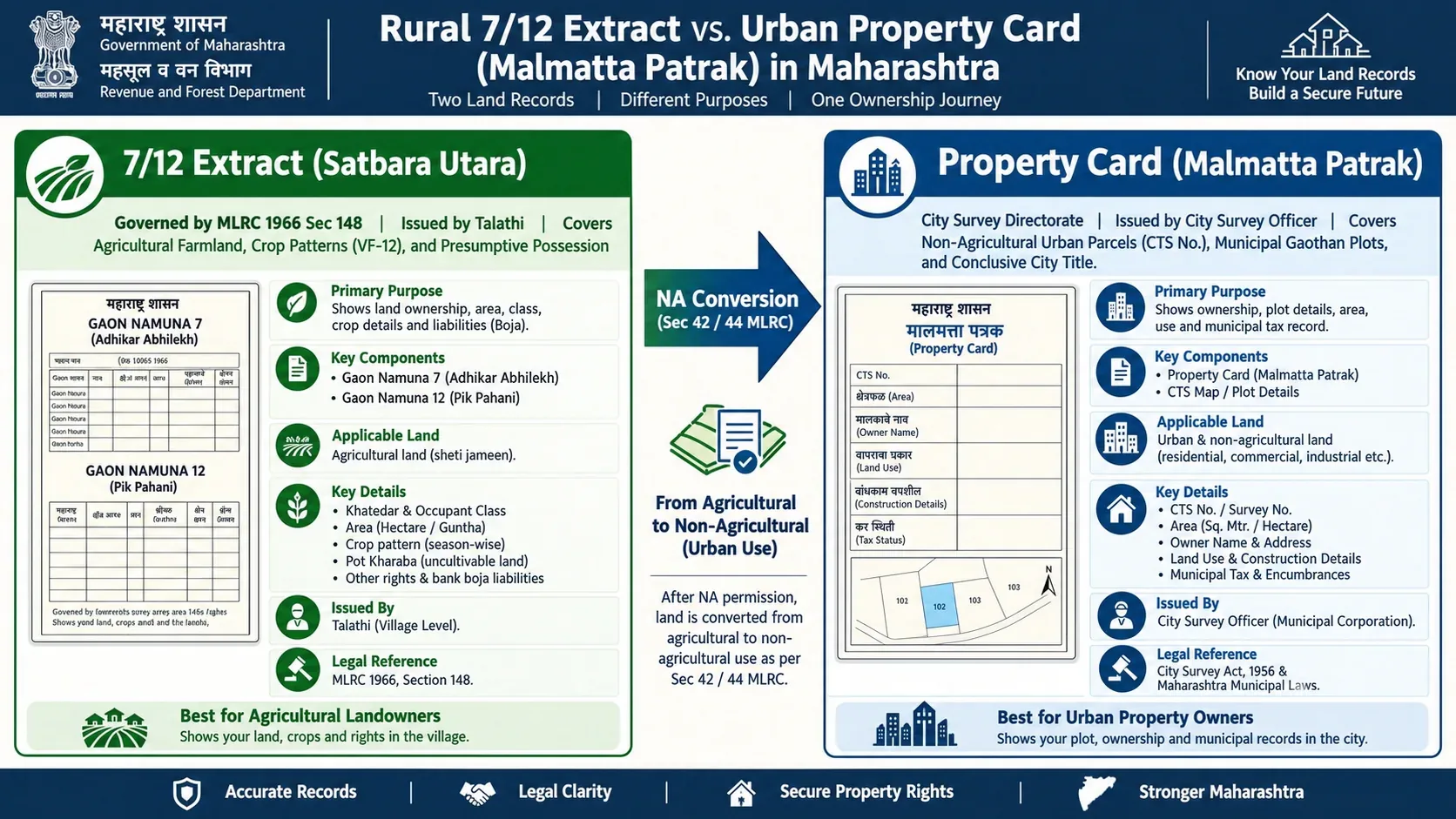
A Maharashtra 7/12 extract combines Village Form 7 (Record of Rights) and Form 12 (Crop Register) for agricultural lands under MLRC Section 148. A Property Card (Malmatta Patrak) is a Record of Rights for lands surveyed under Section 126 in cities, towns, or village sites. Neither document confers title under Supreme Court precedent, and an NA order does not automatically create a Property Card.
Administrative Dimension Fact Sheet
| Administrative Dimension | Statutory Specification & Governance |
|---|---|
| Governing Legislation | Maharashtra Land Revenue Code, 1966 (Sections 126, 128, 148, 157) |
| Rural Record Format | Village Form VII & XII (7/12 Extract / Satbara Utara) |
| Urban & Gaothan Format | Property Card (Malmatta Patrak / Akhiv Patrika under City Survey) |
| Gaothan Survey Notification | Revenue & Forest Department Notification dated 8 March 2019 (Section 126 surveys) |
| Judicial Precedent | Supreme Court ruling dated 15 May 2025 (In Re: Construction of Multi Storeyed Buildings in Forest Land Maharashtra) |
| Jurisdiction Search | MahaBhumi Know Your Jurisdiction Portal |
| Citizen Support Helpdesk | Phone: 020-25712712 | Directorate: 020-26050006 / 020-26050886 (dlrmah.mah@nic.in) |
| Audit & Review Date | 6 November 2026 |
A Maharashtra 7/12 extract and an urban Property Card are both statutory land records under the Maharashtra Land Revenue Code, 1966, but they originate from distinct cadastral frameworks: rural agricultural survey settlements versus urban city survey (CTS / Section 126) registrations. A 7/12 extract combines Village Form 7 (Record of Rights) and Village Form 12 (Crop Register) for agricultural parcels. A Property Card (Malmatta Patrak) represents the Record of Rights prepared for a parcel surveyed under City Survey or village-site provisions. A parcel's governing document derives strictly from its official cadastral survey status under Section 126 of the Maharashtra Land Revenue Code, 1966. Agricultural tracts maintain Village Form 7/12 extracts under rural revenue administration, whereas properties brought under City Survey administration receive City Survey Property Cards. A Non-Agricultural (NA) order under Section 44 MLRC does not automatically generate a Property Card; City Survey demarcation and Sanad issuance by the City Survey Officer must formally conclude before a Property Card supersedes the agricultural extract.
At a Glance: 7/12 Extract vs Property Card
| Point of Comparison | 7/12 Extract | Property Card (Malmatta Patrak) |
|---|---|---|
| Record Context | Village Form 7 is the Record of Rights; Village Form 12 is the crop register. They are commonly issued together as the 7/12 extract. | A Record of Rights in Property Card form for land covered by the applicable city, town or village-site survey and record system. |
| Typical Identifier | Village, survey number or Gat number, and relevant subdivision details. | City Survey Number (CTS/CS) or the identifier used in the relevant survey record. |
| Typical Information | Recorded holders/interests and liabilities, together with crop, season and irrigation-related entries in Form 12. | Recorded holder/interests and parcel details maintained in the Property Card and related city-survey records. |
| Which Office/System? | Village revenue record system; consult the relevant Talathi/revenue office and official 7/12 service. | Land Records / City Survey record system; consult the relevant City Survey Office and official Property Card service. |
| Official Online Service | Mahabhumi / DigitalSatbara 7/12 service. | Mahabhumi Property Card service. |
This statutory comparison outlines governing revenue principles; conclusive title verification requires examining parcel-specific survey maps, registered instruments, and certified mutation entries.
What Does a Maharashtra 7/12 Extract Show?
The Maharashtra Land Records Department maintains Village Form 7 as the statutory Record of Rights and Village Form 12 as the Register of Crops. These registers are issued jointly as the 7/12 extract because their fiscal data is interlinked. Form 7 documents recorded rights, tenures, occupant shares, and statutory encumbrances; Form 12 records crop classifications, agricultural seasons, fallow acreages, and irrigation modes.
Section 148 of the Maharashtra Land Revenue Code, 1966 describes the particulars included in a village Record of Rights, including names of holders, occupants, owners or mortgagees, the nature and extent of their interests, conditions or liabilities, and prescribed additional particulars. Under Section 148 MLRC 1966, the village Record of Rights constitutes an exhaustive fiscal register of proprietary interests, mortgage charges, easements, and state revenue liabilities. Village Form 7 consolidates these legal rights alongside the seasonal agricultural data recorded in Village Form 12. For procedural instructions, consult the Maharashtra 7/12 Guide.
For an agricultural parcel, title counsel must scrutinize the current 7/12 extract in conjunction with the historical mutation register (Village Form 6 Ferfar), the holding ledger (Village Form 8A), and the official cadastral map. A standalone 7/12 extract does not disclose pending revenue disputes or unregistered encumbrances.
What Is a Property Card?
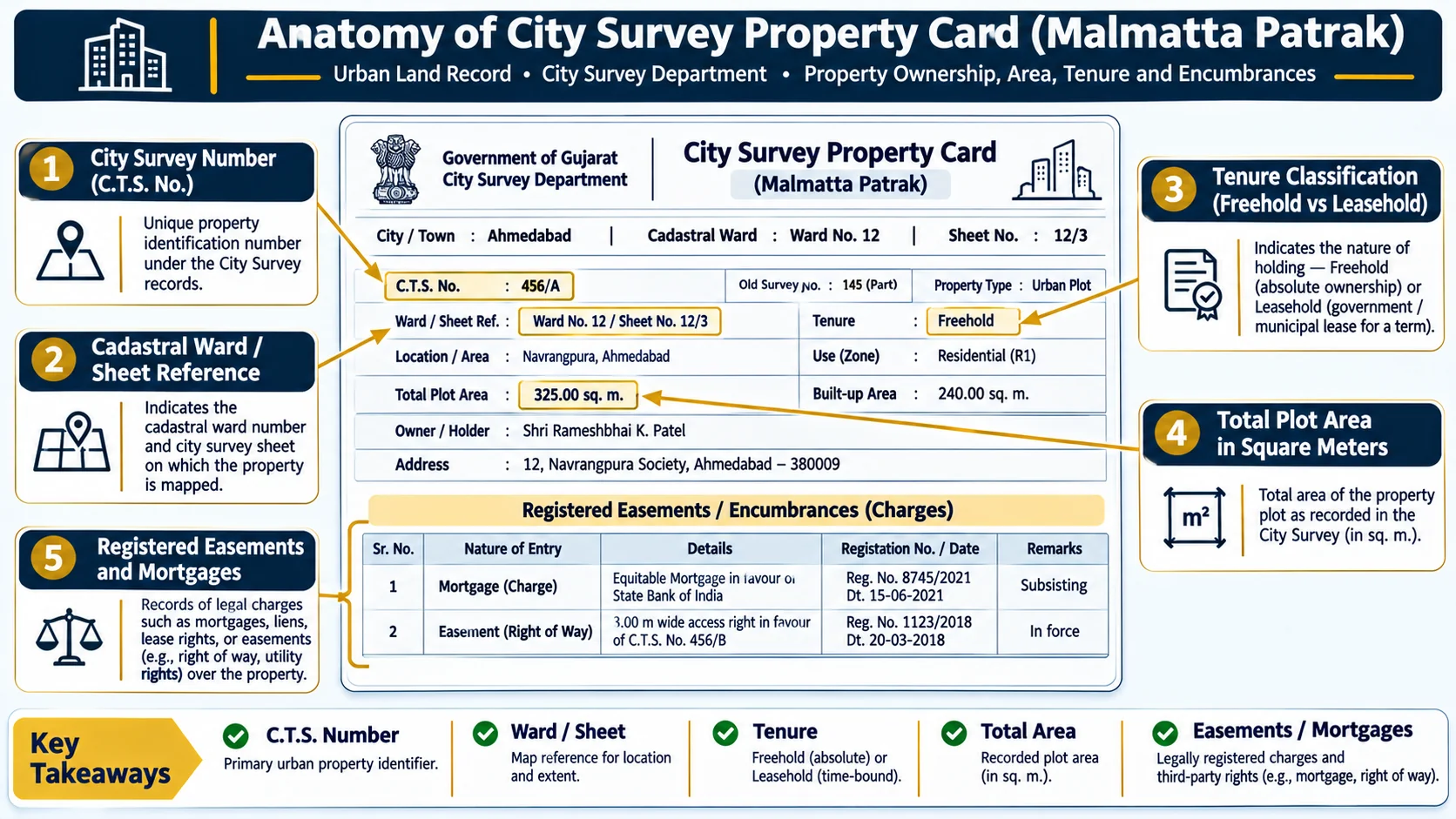
A Property Card (मालमत्ता पत्रक / Malmatta Patrak) constitutes the statutory Record of Rights prepared for parcels surveyed under the urban or village-site cadastral system. Section 126 of the Maharashtra Land Revenue Code, 1966 authorizes surveys of non-agricultural sites within village, town, or city limits. The resultant boundaries and proprietary holdings are recorded in official maps and registers maintained under Section 128.
Property Cards are not confined to parcels situated inside municipal corporation boundaries. By notification dated 8 March 2019, Maharashtra's Revenue and Forest Department directed cadastral surveys under Section 126 for designated non-agricultural lands within rural village sites, excluding municipal corporations, municipal councils, Nagar Panchayats, and pre-surveyed gaothans. The notification mandates that a formal Record of Rights be maintained in Property Card format for every identified parcel in the designated area.
Consequently, a Property Card may govern parcels within rural village abadi or gaothan areas, and a municipal postal address alone does not determine the applicable revenue register. Parties must ascertain the precise cadastral survey status and jurisdictional mapping directly from the Land Records Department.
Does an NA Order Automatically Replace the 7/12?
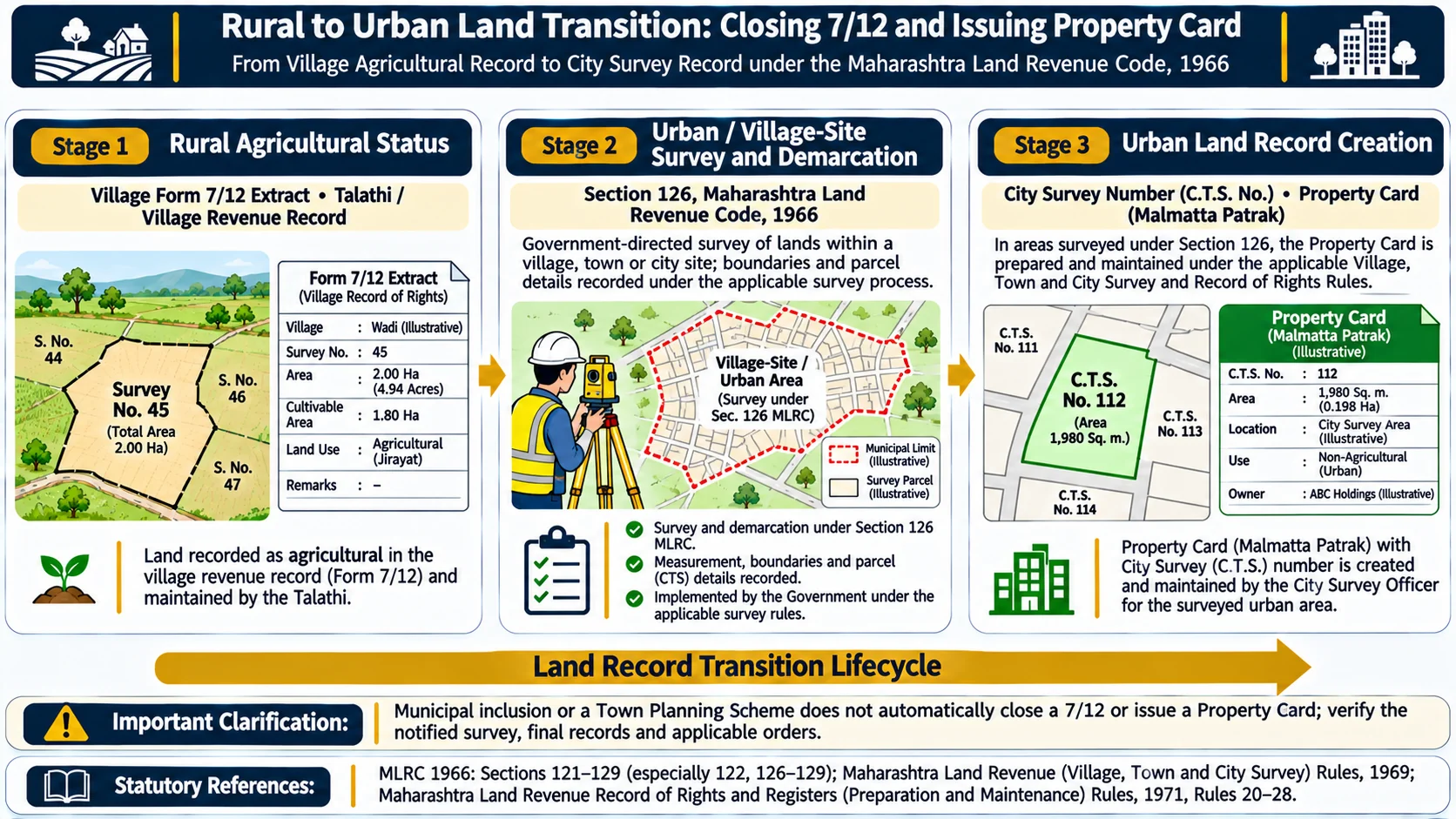
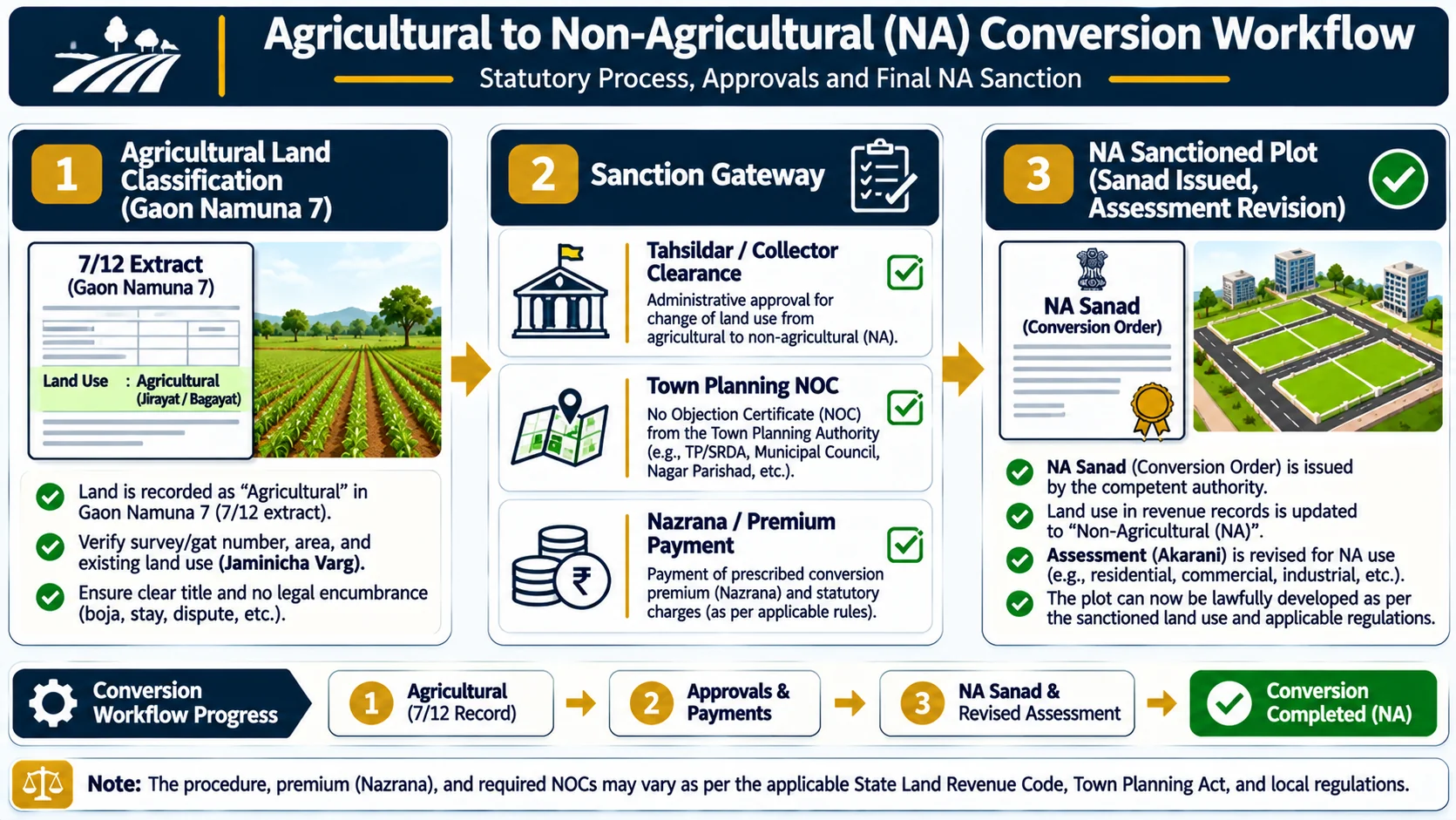
Statute establishes no automatic transition from a 7/12 extract to a Property Card upon land conversion. Non-agricultural (NA) permission granted under Section 44 MLRC and the constitution of a City Survey Property Card under Section 126 represent separate statutory processes. Section 126 requires a formal cadastral survey and settlement before a Property Card can be prepared and recognized in law.
An NA conversion order does not close an existing 7/12 extract, assign a City Survey (CTS) number, or generate a Property Card. For any specific parcel, legal counsel must verify whether a formal cadastral survey under Section 126 has been completed and whether the City Survey Officer has formally opened a Property Card ledger. Where both records appear in the historical chain, secure the mutation extract (Ferfar), survey sanction, and Sanad from the competent revenue authority to confirm current legal tenure.
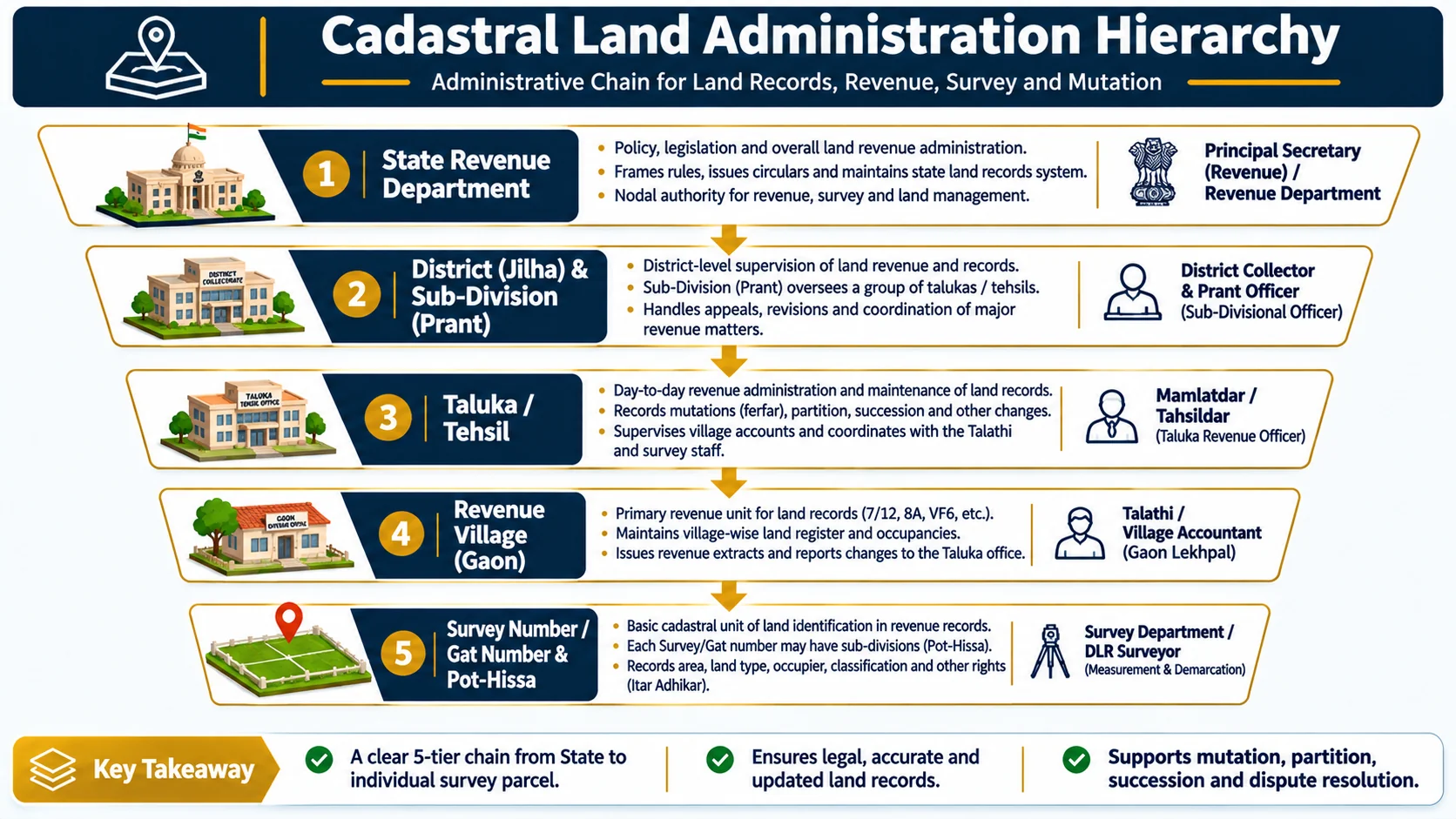
How to Identify Which Record Applies to Your Property
- Collect the Parcel Identifiers: Note the district, taluka, village or peth, survey/Gat number, subdivision and, if available, CTS/City Survey number.
- Check the Official Jurisdiction: Use the Maharashtra Land Records Department's Know your Jurisdiction service to search using the relevant ULPIN, CTS number, survey number or village information where available.
- Check Both Official Record Services If Uncertain: The department lists separate services for 7/12 extracts and Property Cards. Confirm that the selected result matches the parcel identifier and location.
- Obtain the Appropriate Certified/Digitally Signed Record: The department distinguishes view-only records from digitally signed copies intended for official use. Follow the instructions shown on DigitalSatbara.
- Compare the Record with Its Supporting Documents: Review mutation history, survey maps on MahaBhunaksha, registered conveyance documents, relevant permissions and any court or authority orders.
If parcel identifiers conflict or both record formats appear simultaneously, parties must not resolve the conflict based on locality assumptions. Submit a formal jurisdictional inquiry to the jurisdictional Tahsildar or City Survey Officer to obtain written certification of the governing cadastral register.
Does a Property Card or 7/12 Prove Ownership?
Neither a 7/12 extract nor a Property Card constitutes an indefeasible title deed. Under Section 157 of the Maharashtra Land Revenue Code, 1966, an entry in the Record of Rights and a certified mutation entry enjoy a rebuttable presumption of truth until contrary evidence is established or an entry is lawfully substituted. An evidentiary presumption for fiscal assessment does not equate to conclusive proprietary ownership.
The Supreme Court of India has settled that entries in revenue registers neither create nor extinguish title to immovable property. In its landmark judgment of 15 May 2025 in In Re: Construction of Multi Storeyed Buildings in Forest Land Maharashtra, the Supreme Court reaffirmed that revenue entries do not confer proprietary title. A purchaser must conduct independent verification of registered conveyances, search Sub-Registrar records for 30 years, verify sanctioned building plans, and confirm non-encumbrance in accordance with our Buyer Due Diligence Checklist.
For multi-family residential apartments, the registered agreement for sale or deed of apartment, along with cooperative housing society share certificates, forms the primary title record; the underlying land record (whether 7/12 or Property Card) serves to confirm that the developer possessed clear, marketable freehold or leasehold rights to convey.
Official Portals and Primary References
- Maharashtra Land Records Department: Services Directory: Separate 7/12, 8A, Ferfar and Property Card services.
- Maharashtra Land Records Department: FAQs: Definitions of Village Form 7, Form 12 and the 7/12 extract.
- Know your Jurisdiction Portal: Search tools for Property Card and 7/12 jurisdiction.
- Maharashtra Land Revenue Code, 1966: Official Law and Judiciary Department publication.
- Revenue and Forest Department Notification dated 8 March 2019: Section 126 survey direction for specified village-site lands.
- Supreme Court Judgment dated 15 May 2025: Judicial affirmation on the legal effect of revenue-record entries.
Related Digital712 guides: Maharashtra 7/12 Guide | Download Digitally Signed 7/12 | MahaBhunaksha Cadastral Maps | Land Due Diligence Checklist.
Frequently Asked Questions
Is a 7/12 extract only for agricultural land?
The 7/12 is the combined Village Form 7 Record of Rights and Form 12 crop register. Its use depends on the village record maintained for the parcel. Do not decide from the land's present physical use alone.
Can a village property have a Property Card?
Yes. The 8 March 2019 Maharashtra notification directs a Section 126 survey and Property Card-form Record of Rights for specified non-agricultural-use lands within village sites, subject to the exclusions stated in the notification.
Does being inside a municipal limit mean I must use a Property Card?
Not necessarily. The municipal boundary by itself is not enough to identify the record for a specific parcel. Verify the parcel's survey and land-record jurisdiction with the Land Records Department.
Does NA permission automatically create a Property Card?
No. The sources cited here describe NA land-use permission and the Section 126 survey/Property Card process as distinct matters. Confirm whether the parcel has actually been surveyed and a Property Card opened.
Which document should I check before buying land?
Check the official record maintained for that parcel (either a 7/12 or a Property Card) and review the mutation history, survey map and registered title documents. The correct due-diligence set depends on the property and transaction.
Does a Property Card conclusively prove ownership?
No. A land-record entry has evidentiary significance, but it is not a standalone guarantee of title. Review the underlying registered instruments and seek qualified legal advice for a transaction or dispute.