
Gujarat Land Records: How to Check AnyRoR and Understand Village Forms
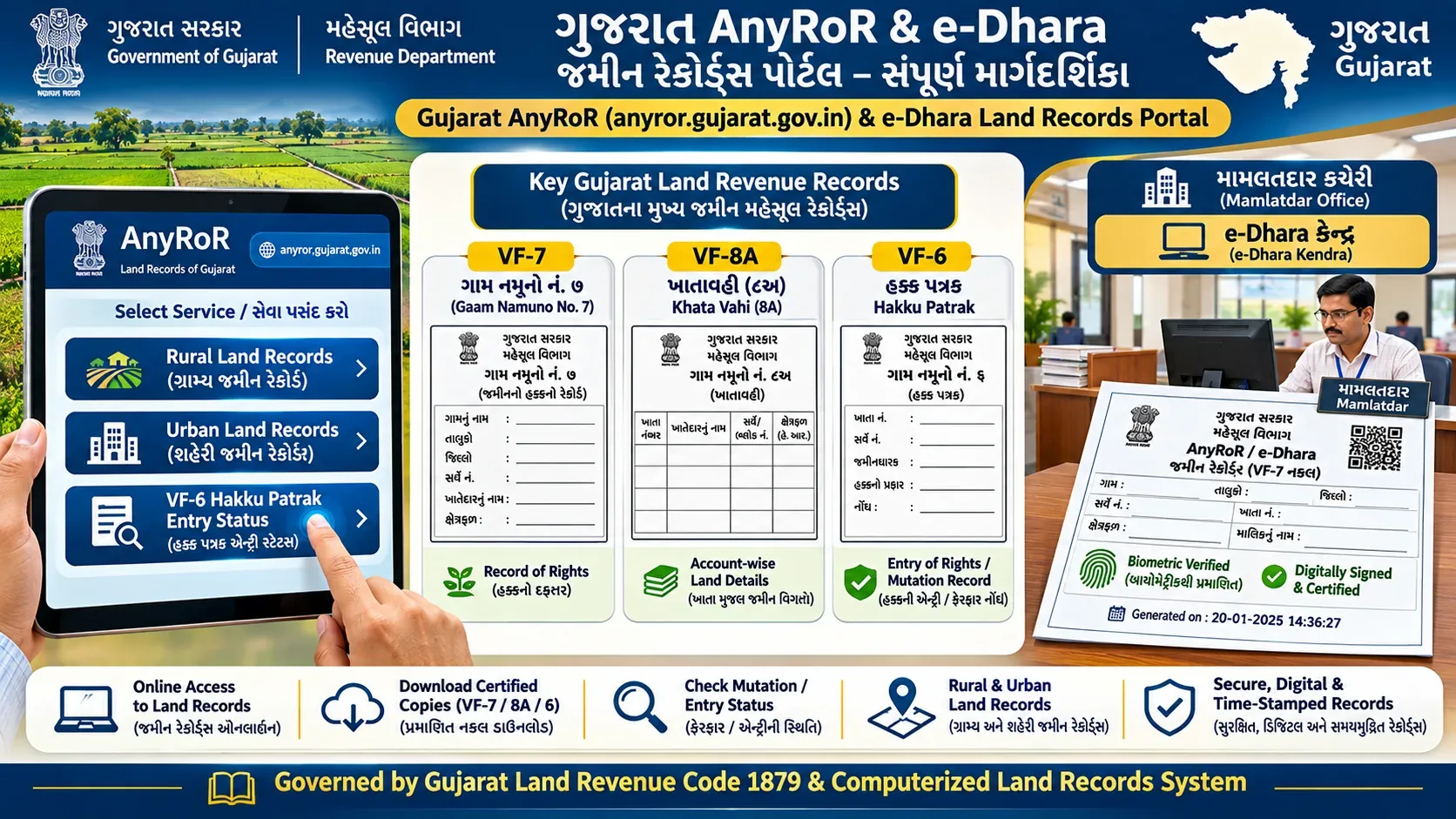
Gujarat land records are accessible online via AnyRoR for rural Record of Rights and e-Milkat for urban Property Cards. Village Forms 7 and 12 were separated under the 16 March 2012 circular. Village Form 6 records mutations under Section 135D, and Form 8A records khata holdings. Revenue entries carry a rebuttable presumption under Section 135J and do not confer title.
Administrative Dimension Fact Sheet
| Administrative Dimension | Statutory Specification & Governance |
|---|---|
| State Jurisdiction | State of Gujarat (Revenue Department) |
| Governing Codes | Gujarat Land Revenue Code, 1879 & Gujarat Tenancy and Agricultural Lands Act, 1948 |
| Rural Viewing Portal | AnyRoR Official Portal - Rural Record of Rights Viewing |
| Urban Property Card | e-Milkat Urban Property Portal - City Survey Records |
| Online Applications | iORA Integrated Revenue Portal - Integrated Online Revenue Applications |
| Registration & Jantri | GARVI Valuation and Registration Portal - Valuation and Deed Registration |
| Evidentiary Status | Presumption of truth under Section 135J GLRC; ownership title determined by civil courts |
| Audit & Review Date | 6 November 2026 |
Gujarat administers agricultural and non-agricultural revenue through distinct statutory databases. Rural agricultural records are accessed through AnyRoR, while urban properties within City Survey boundaries are administered through e-Milkat.
Check Gujarat Land Records Online: Official Portals
Verify rural land parcels through the AnyRoR rural database. For urban properties within City Survey limits, inspect Property Cards on e-Milkat.
| Service | Official Link | Statutory Purpose |
|---|---|---|
| AnyRoR | Rural Record of Right viewing | Online inspection of rural agricultural land registers (VF-7, VF-8A, VF-6). |
| e-Milkat | Property Card viewing | Online viewing of urban City Survey Property Cards (Milkat Card). |
| iORA | Online revenue applications | Integrated portal for NA permission, premium payments, and agricultural certifications. |
| GARVI | Registration and Jantri services | Document registration, market valuation (Jantri rates), and stamp duty payment. |
| Revenue Department | Official online-services directory | Departmental circulars, notifications, statutory manuals, and administrative orders. |
| e-Dhara Information | Gujarat Informatics Limited | Taluka-level computerized land management and certified copy issuance infrastructure. |
Statutory Clarification: Digital712 operates as an independent civic legal intelligence platform; Gujarat land record modification, certified copy issuance under Section 135K GLRC, and dispute adjudication belong exclusively to the Gujarat Revenue Department and Mamlatdar offices.
What Is AnyRoR Gujarat?
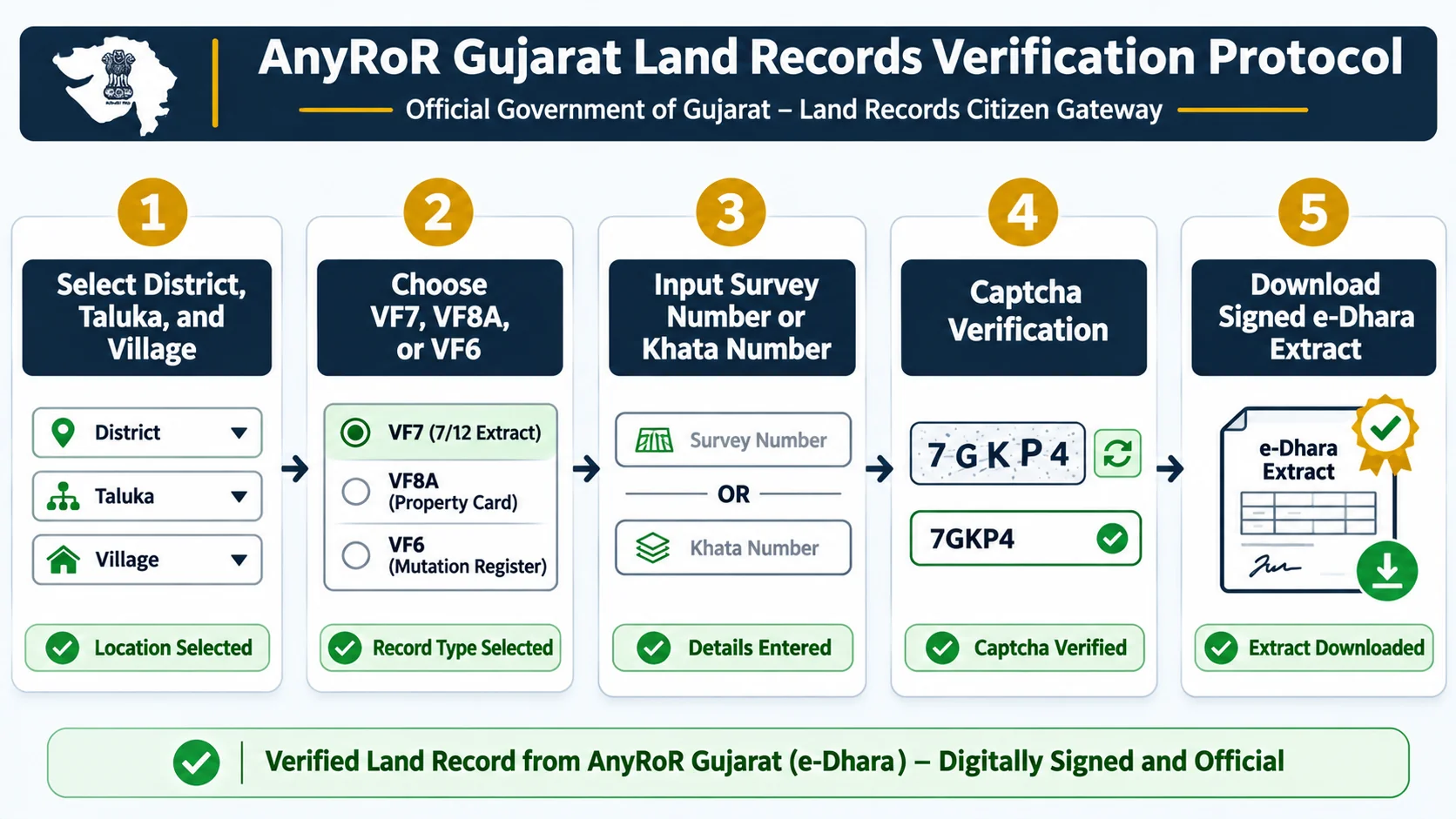
AnyRoR (Any Records of Rights Anywhere) is the Gujarat Government portal for inspecting computerized rural land records. Operating under the Revenue Department, it provides uncertified public inspection of agricultural holdings across all 33 districts and 250+ talukas.
For urban properties, the state maintains the independent e-Milkat portal. Rural survey numbers and urban City Survey (CTS) numbers represent mutually exclusive territorial jurisdictions under the Gujarat Land Revenue Code, 1879.
Online Viewing Versus a Certified Copy
Portal extracts generated via AnyRoR serve purely informational and preliminary verification functions. For judicial evidence, bank loan creation, or registered deed execution, citizens must procure a certified copy issued under Section 135K GLRC from the jurisdictional Taluka Mamlatdar or e-Dhara Kendra bearing an official revenue seal.
Gujarat Village Forms: VF-7, VF-12, VF-8A and VF-6
Under the Gujarat Land Revenue Rules, village accountants (Talati-cum-Mantris) maintain four primary revenue ledgers. Revenue Department Circular LRC-102012/15/41 dated 16 March 2012 formally uncoupled Form 12 from Form 7, establishing distinct digital registers.
Village Form 7 (VF-7): Record of Rights
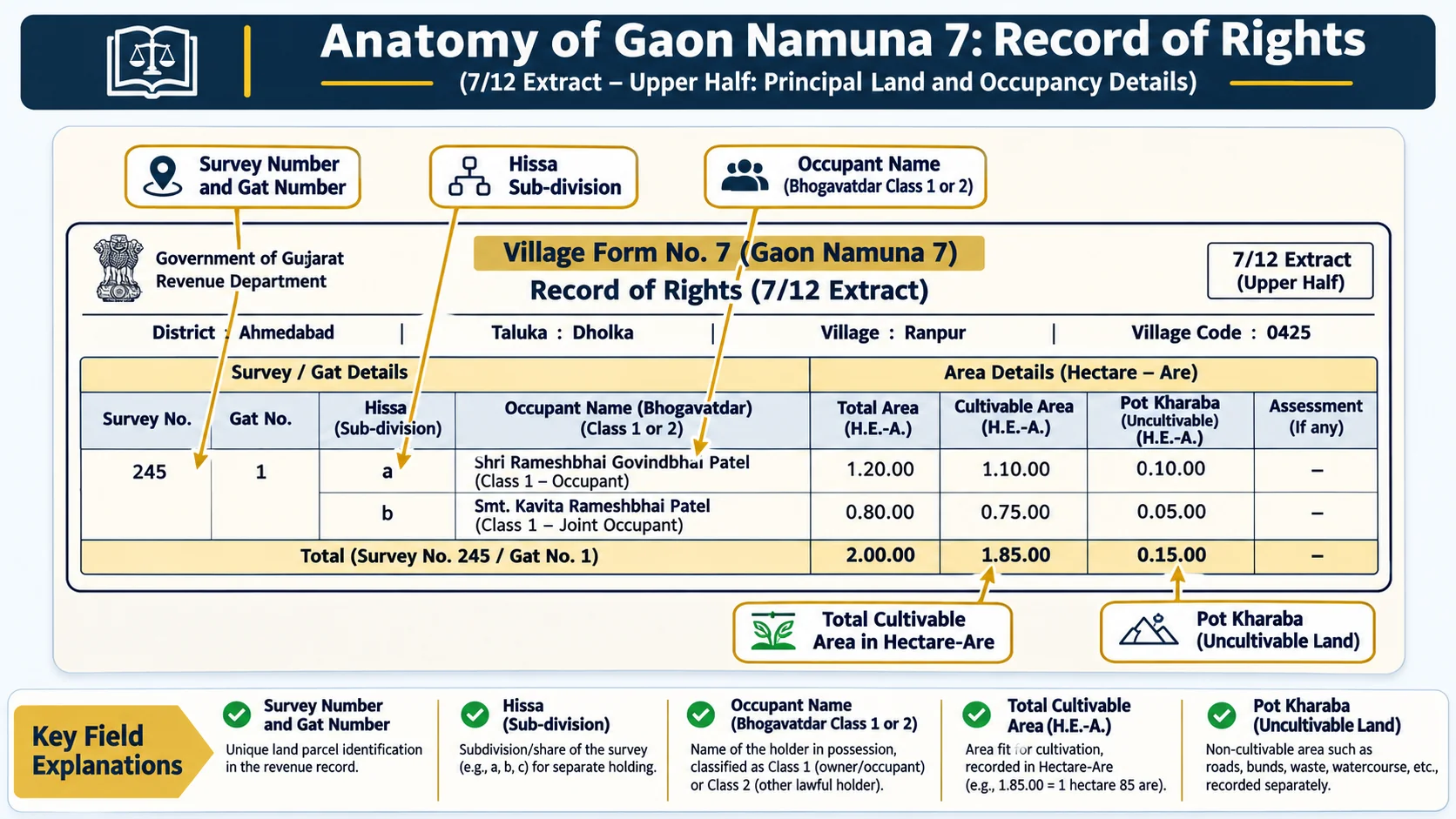
VF-7 details the parcel survey number, registered occupant names, total area, tenure classification (Old or New Tenure), and the other rights (Itar Hakka) column listing bank mortgages, government charges, and court injunctions.
Village Form 12 (VF-12): Crop Cultivation Register
VF-12 documents seasonal agricultural usage, including crop varieties, irrigated versus rain-fed acreage, fallow land, and active cultivators. It serves as statutory evidence in crop loss compensation claims and tenancy disputes.
Village Form 8A (VF-8A): Khata Holding Ledger
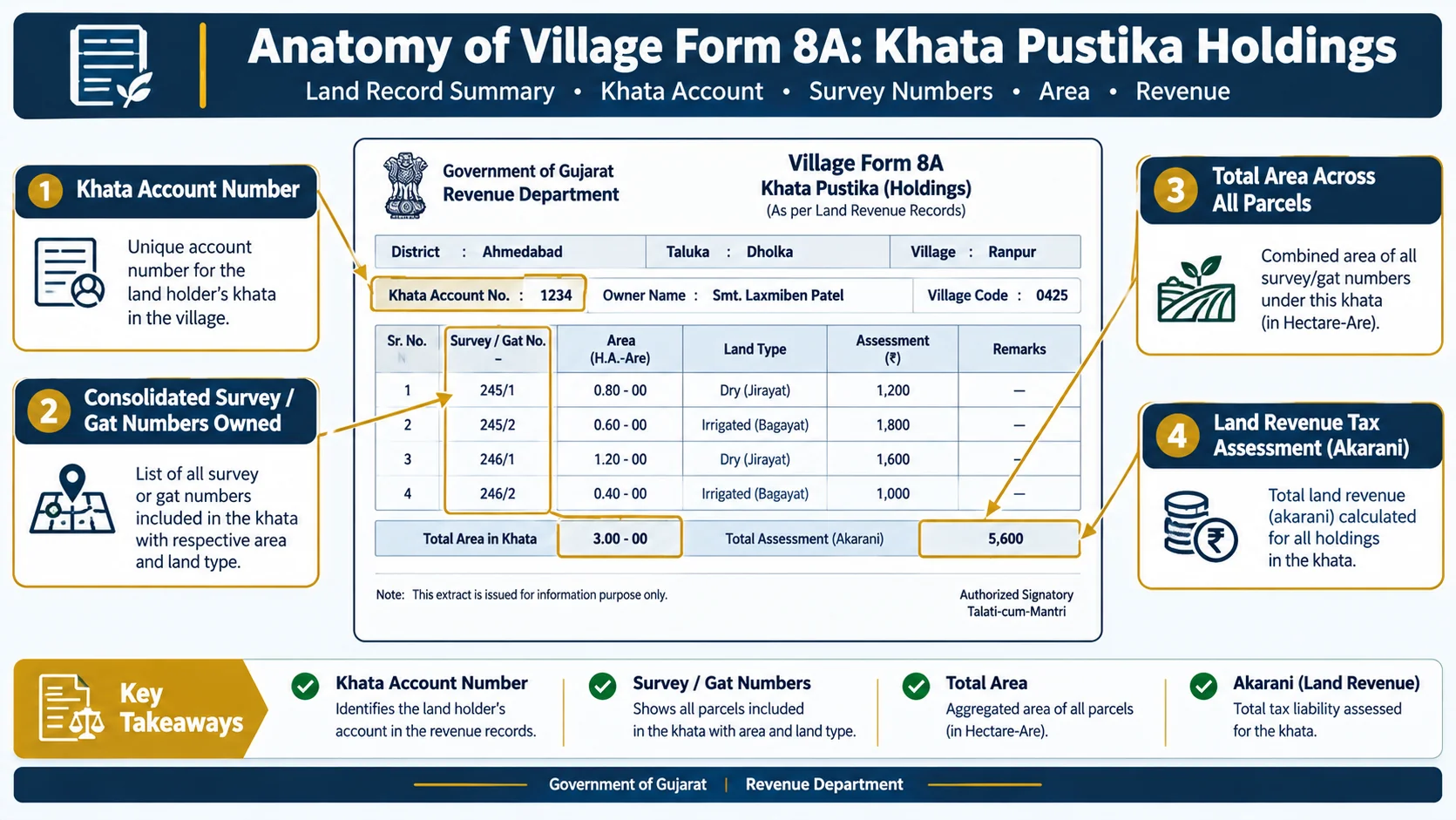
Form 8A acts as the citizen's consolidated land account (Khatavahi), aggregating all survey numbers owned by a landholder within a revenue village and itemizing their annual land revenue assessment liability.
Village Form 6 (VF-6): Hakka Patrak Mutation Register
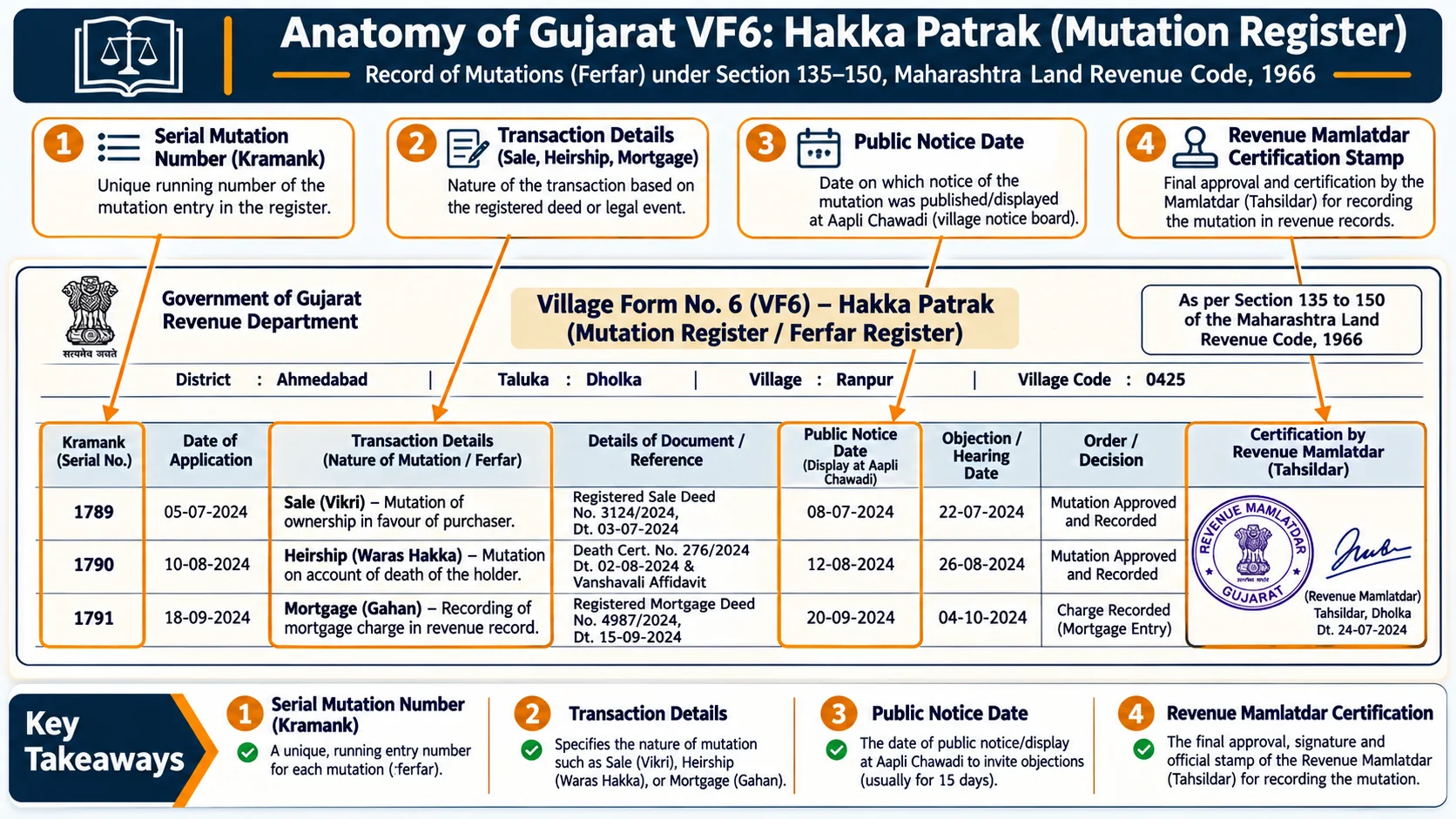
VF-6 records every transaction altering land ownership or liabilities, including sale deeds, inheritance successions (Varai), mortgage entries, partitions, and land acquisition awards. Entries remain provisional until formally certified by the Circle Officer or Mamlatdar.
How to Check Gujarat Land Records on AnyRoR
To inspect rural land records on the AnyRoR portal, follow this procedural sequence:
- Navigate to the official portal: AnyRoR Gujarat Portal.
- Select View Land Record - Rural from the primary menu.
- Select the required record type (VF-7, VF-8A, VF-6 mutation entry, or 135D notice).
- Select District, Taluka, and Revenue Village from the dropdown selectors.
- Enter the Survey/Block Number, Khata Number, or Mutation Entry Number.
- Solve the security captcha and click Get Record Detail to display the uncertified extract.
Always verify that the displayed taluka, village code, and landholder names match your registered sale deed or revenue receipts.
What Is e-Dhara in Gujarat?
e-Dhara is Gujarat's computerized land records network, replacing manual village registers with digital ledgers maintained at Taluka Mamlatdar centers. Operating through dedicated e-Dhara Kendras at Taluka Mamlatdar offices, it provides:
- Computerized registration of mutation requests upon submission of registered sale deeds or succession notices.
- Automated generation and dispatch of statutory notices under Section 135D GLRC.
- Direct issuance of tamper-evident certified copies of Village Forms 7, 8A, and 6 upon payment of nominal statutory user fees.
- Centralized data synchronization preventing unauthorized off-line alterations by village talatis.
Gujarat Mutation Entries: VF-6 and Section 135D
Section 135D of the Gujarat Land Revenue Code, 1879 regulates the statutory procedure for recording rights alterations. Upon receiving notice of a transaction, the Talati enters the mutation into Village Form 6 and serves individual notices to all affected parties, displaying a public notice copy at the village Chavdi for 30 days.
If no objections are lodged within 30 days, the Circle Officer inspects the documents and certifies the entry. If a dispute is raised, the matter is registered as a Disputed Case and adjudicated by the Mamlatdar under quasi-judicial powers.
2026 Statutory Amendment: Accelerated Mutation Route
The Gujarat Land Revenue (Amendment) Ordinance, 2026 (Gazette notification dated 31 March 2026) introduced an accelerated mutation procedure for registered sale deeds meeting three statutory requirements:
- The land parcel has had no recorded title alteration in the preceding 12 months.
- All registered co-holders appearing in VF-7 have executed the registered conveyance deed.
- No revenue inquiry, civil court injunction, or land ceiling dispute is pending on the execution date.
Understanding Juni Sharat and Navi Sharat Land
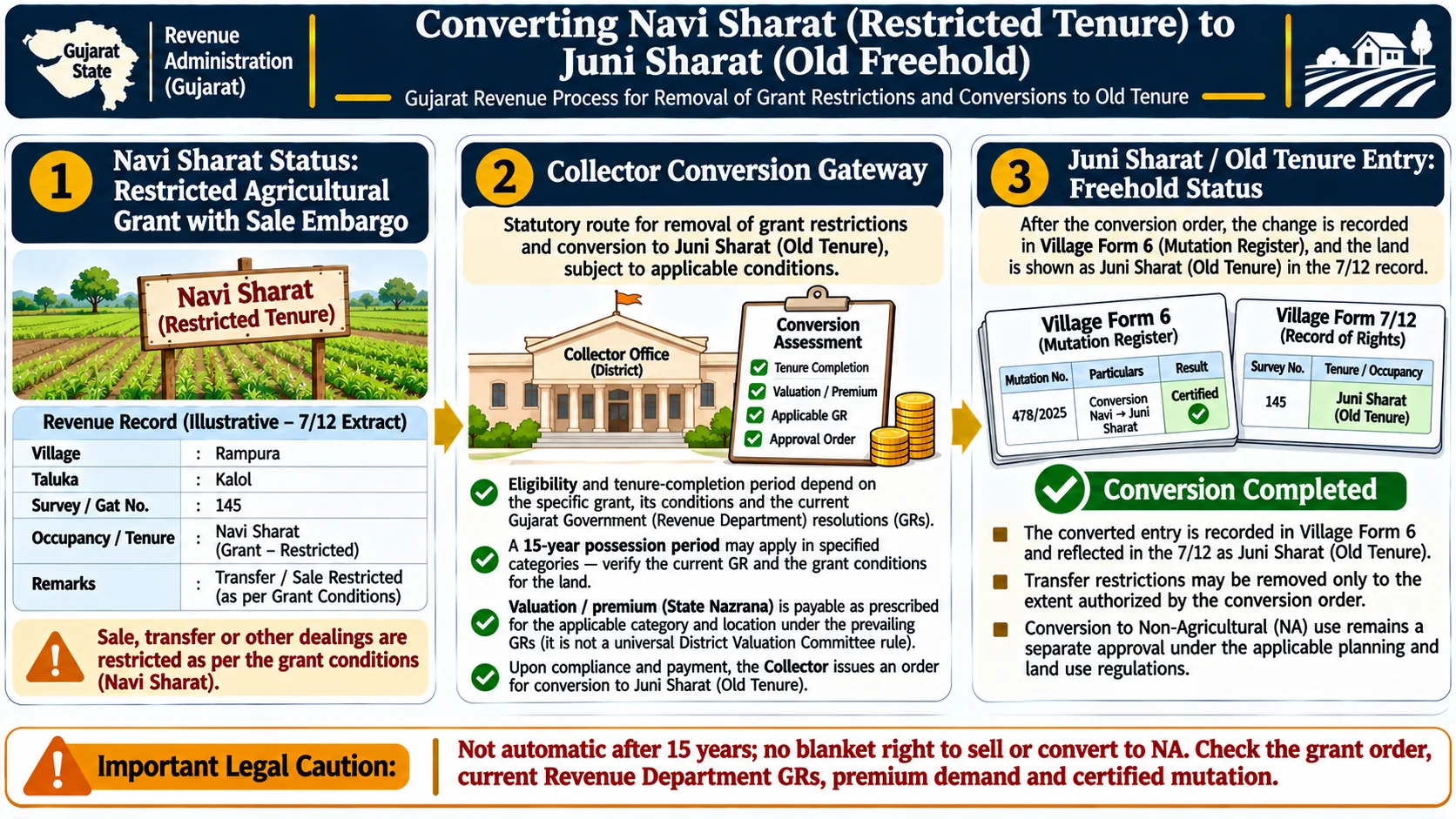
Land tenure in Gujarat is divided into two distinct legal classes with different alienation rights:
| Tenure Classification | Statutory Transferability | Legal Restrictions & Approvals |
|---|---|---|
| Juni Sharat (Old Tenure) | Freely transferable to eligible agriculturists. | No prior Collector sanction required; subject only to Section 63 tenancy eligibility. |
| Navi Sharat (New/Restricted Tenure) | Restricted; transfer or mortgage barred without sanction. | Requires prior District Collector permission, payment of statutory state premium (Najarana), and compliance with Section 43/73AA. |
Purchasing Navi Sharat land without prior Collector sanction and premium clearance renders the transaction void under Section 84C of the Tenancy Act, vesting the land in the state government.
Agricultural Land Purchase Restrictions in Gujarat
Section 63 of the Gujarat Tenancy and Agricultural Lands Act, 1948 prohibits the sale, gift, exchange, or lease of agricultural land to any person who is not a certified agriculturist. Key legal provisions include:
- Agriculturist Status: A buyer must hold agricultural land in the State of Gujarat to qualify as an agriculturist. Holding agricultural land in other states does not confer eligibility in Gujarat.
- Bona Fide Industrial Use (Section 63AA): Non-agriculturists may acquire agricultural land for bona fide industrial use by notifying the Collector and commencing industrial production within the prescribed statutory period (typically 3 to 5 years).
- Tribal Land Restrictions (Section 73AA): Agricultural land owned by Scheduled Tribes cannot be transferred to non-tribals without prior sanction from the District Collector.
Gujarat Land Measurement: Hectares, Ares, Gunthas and Vigha
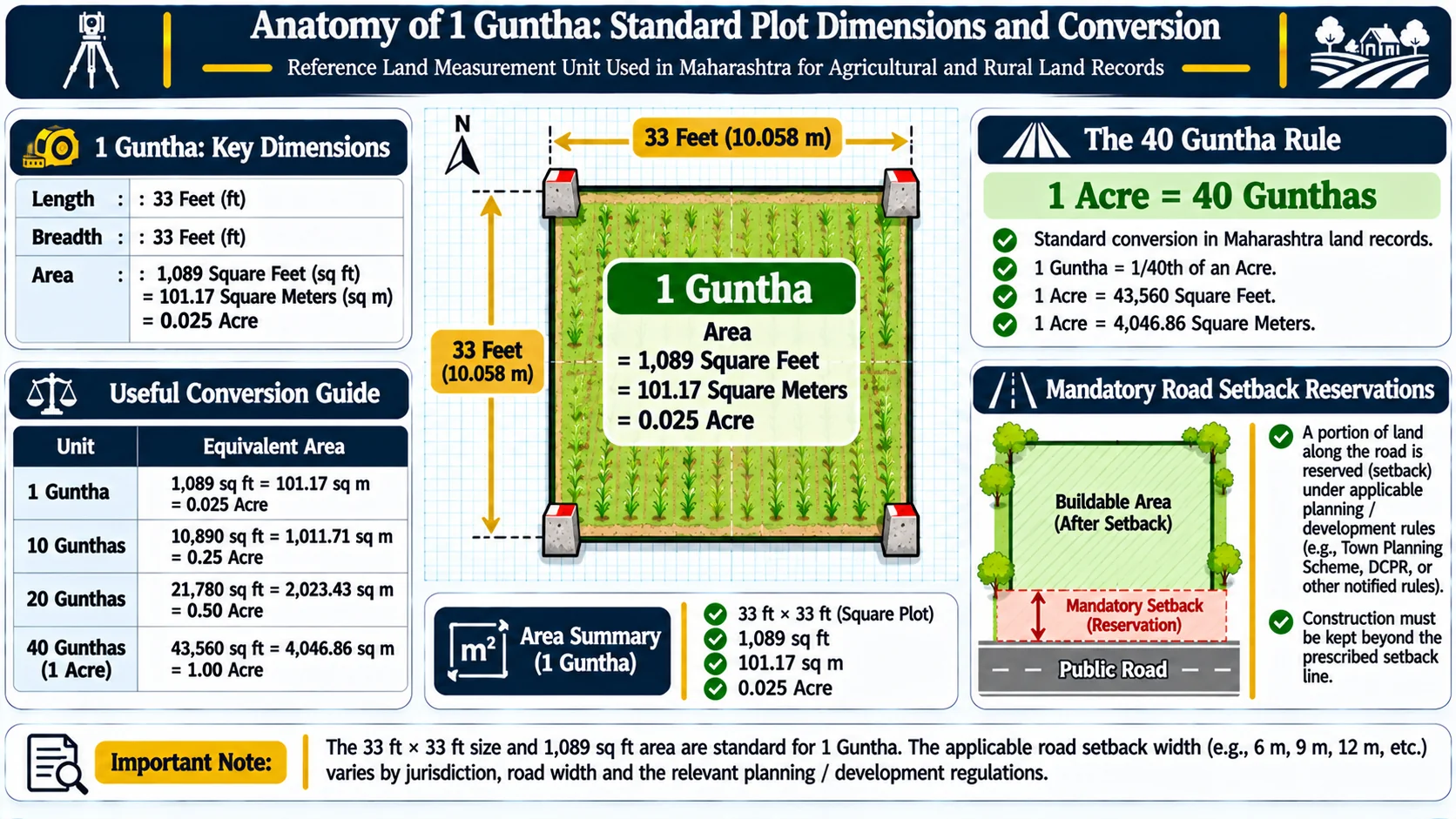
Official revenue records in Gujarat record parcel dimensions in the metric system (Hectare, Are, Square Metre). However, local land dealings commonly reference the customary Vigha, which varies significantly by region:
| Measurement Unit | Standard Metric Equivalence | Regional Application Notes |
|---|---|---|
| 1 Hectare | 10,000 sq. metres (100 Ares / 2.471 Acres) | Universal official revenue recording unit on VF-7. |
| 1 Are | 100 sq. metres (1.076 Gunthas) | Standard sub-unit used in revenue surveys. |
| 1 Guntha | 1,089 sq. feet (101.17 sq. metres) | Common surveying denominator across western India. |
| 1 Vigha (Central / North Gujarat) | Approximately 23,760 sq. feet (2,207 sq. metres) | Standard Vigha (equivalent to 16 Gunthas). |
| 1 Vigha (Saurashtra / Kutch) | Approximately 17,424 sq. feet (1,619 sq. metres) | Small Vigha (equivalent to 16 Gunthas of 100 sq. yards each). |
Use our Land Area Metric Calculator to verify conversions before drafting purchase agreements.
ULPIN and Land Parcel Identification
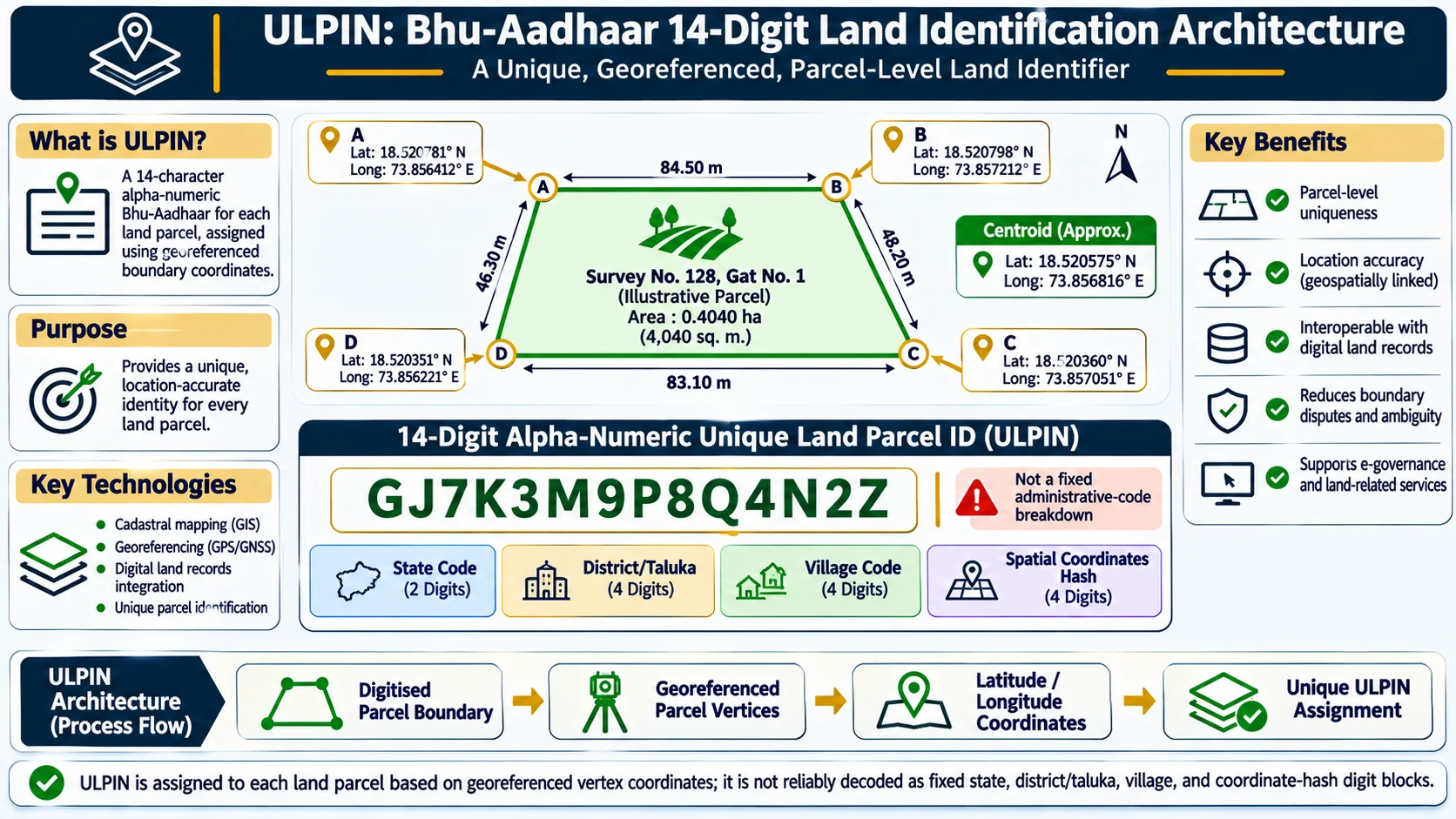
Under the national DILRMP framework, Gujarat has implemented the Unique Land Parcel Identification Number (ULPIN), branded as Bhu-Aadhaar. This 14-digit alphanumeric code is generated from the longitude and latitude coordinates of the parcel's cadastral boundary vertices.
ULPIN eliminates survey discrepancies, identifies fragmented hissas, and connects AnyRoR revenue entries directly with GARVI registered deeds and digital cadastral maps.
How to Read a Gujarat Land Record
When auditing a Gujarat Village Form 7 extract, apply this rigorous 7-point verification protocol:
- Verify Administrative Hierarchy: Check district, taluka, and village names to ensure jurisdictional alignment.
- Cross-Check Survey/Block Number: Ensure the survey or re-survey block number matches title deeds and cadastral maps.
- Audit Recorded Occupants: Verify whether the seller holds sole ownership or shared joint tenancy with undivided shares.
- Inspect Tenure Classification: Confirm whether the record states Juni Sharat or Navi Sharat.
- Examine the Other Rights Column (Itar Hakka): Inspect for encumbrances, bank hypothecations, government takavvi loans, or court stay orders.
- Verify Pending Pencil Entries: Check if any uncertified mutation numbers are listed in brackets, indicating pending title disputes.
- Cross-Reference with VF-6 and VF-8A: Inspect the mutation register to review the historical chain of title leading to the current holding.
Before Buying Land in Gujarat: Due-Diligence Checks
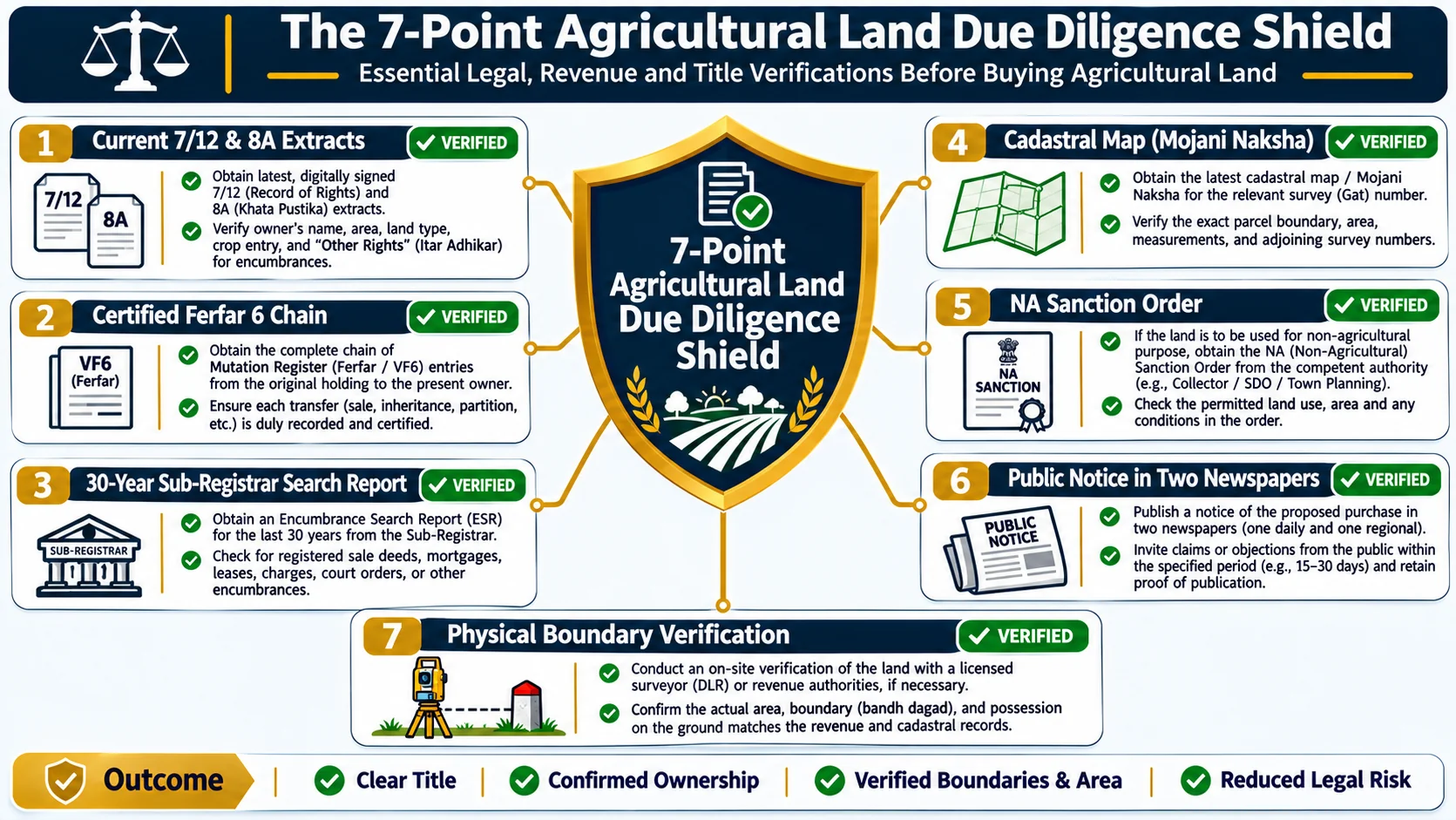
Revenue extracts establish presumptive fiscal liability but do not guarantee clear ownership title. Prior to executing a transaction, complete these essential due-diligence verifications:
- 30-Year Search Report: Procure registered deed index extracts from the Sub-Registrar Office via the GARVI portal.
- Certified Record of Rights: Obtain certified copies of VF-7, VF-8A, and historical VF-6 mutations from the e-Dhara Kendra.
- Tenure & Permissibility Verification: Ensure non-agriculturists do not execute agricultural agreements without Section 63AA clearances.
- Bank No-Objection Certificate: If an active Boja is recorded in the Itar Hakka column, require a registered release deed before disbursing funds.
- Cadastral Mojani Survey: Conduct an on-site demarcation survey by an authorized government surveyor (DILR) to confirm boundary markers.
- Public Title Notice: Issue a statutory notice in two regional newspapers allowing 14 days for public claims.
For an expanded legal audit framework, consult our Buyer Due Diligence Checklist.
Gujarat and Maharashtra Land Records: Key Differences
| Parameter | Gujarat Revenue Framework | Maharashtra Revenue Framework |
|---|---|---|
| Governing Code | Gujarat Land Revenue Code, 1879 | Maharashtra Land Revenue Code, 1966 |
| Form 7 and 12 Separation | Separated into independent forms (16 March 2012 circular) | Maintained as unified single 7/12 extract |
| Viewing Portal | AnyRoR (AnyRoR Gujarat Portal) | Mahabhulekh (Mahabhulekh Portal) |
| Digitally Signed Downloads | Through iORA and e-Dhara Kendras | Through DigitalSatbara (DigitalSatbara Portal) |
| Mutation Ledger | Village Form 6 (Hakka Patrak) | Village Form 6 (Ferfar Patrak) |
| Urban Title Register | e-Milkat Property Card | City Survey Property Card (PR Card) |
Frequently Asked Questions About Gujarat Land Records
How can I check Gujarat land records online?
Access the AnyRoR portal, select View Land Record - Rural, select the required form (VF-7, VF-8A, or VF-6), and input your district, taluka, village, and survey or khata number.
What is AnyRoR?
AnyRoR is the official Gujarat Government revenue portal providing public online viewing access to computerized rural land records across the state.
What is the difference between VF-7 and VF-12?
VF-7 contains the Record of Rights, parcel dimensions, occupant names, and liabilities. VF-12 contains seasonal crop cultivation details. They were uncoupled under Revenue Department Circular dated 16 March 2012.
What is VF-8A?
VF-8A is the village khata holding ledger linking a landholder's account with all individual survey parcels owned in that village and stating their total land revenue assessment.
What is VF-6 or Hakk Patrak?
VF-6 is the mutation register recording all reported title transfers, successions, mortgages, and partitions before they are formally certified and incorporated into VF-7.
What is e-Dhara?
e-Dhara is Gujarat's computerized revenue administration network operating at Taluka Mamlatdar offices for recording mutations and issuing certified land record copies.
Does an AnyRoR record prove ownership?
No. Section 135J GLRC establishes a rebuttable presumption of truth for revenue purposes. As held in Jitendra Singh v. State of MP (2021), revenue records do not confer or extinguish ownership title.
Does every mutation take 30 days?
Standard mutations involve a 30-day objection period under Section 135D. However, the Gujarat Land Revenue (Amendment) Ordinance, 2026 permits same-day certification for qualifying undisputed registered sale deeds.
Can a non-agriculturist purchase agricultural land in Gujarat?
No. Section 63 of the Gujarat Tenancy and Agricultural Lands Act, 1948 bars transfers to non-agriculturists without prior Collector sanction, except for bona fide industrial use under Section 63AA.
Is one Vigha the same size everywhere in Gujarat?
No. Vigha is a customary regional measurement: a standard Vigha in Central/North Gujarat is approximately 23,760 sq. ft., whereas in Saurashtra it is 17,424 sq. ft. Always rely on metric hectares and ares.
What is ULPIN?
ULPIN (Bhu-Aadhaar) is a 14-digit geospatial parcel identifier generated from boundary coordinates to provide unique, tamper-proof cadastral identity under DILRMP.
Official Gujarat Land-Record References
- Gujarat Revenue Department: Official portal directory for rural Record of Rights and Property Cards.
- e-Dhara Project (GIL): Technical specification of computerized e-Dhara Kendra mutation workflows.
- Gujarat Collector Manual: Statutory rules for Village Forms 6, 7, 12, 8A, and circular dated 16 March 2012.
- Gujarat Land Revenue Code, 1879: Statutory foundation for Sections 135D, 135J, and 135K.
- Supreme Court Ruling: Jitendra Singh (2021): Establishes that revenue entries do not confer title.
- GLRC Amendment Ordinance, 2026: Gazette notification dated 31 March 2026 for Section 135D mutations.
- Gujarat Tenancy Act, 1948: Statutory restrictions on agricultural land transfers under Section 63.
Statutory Source Notice: Verified against official notifications as of 6 November 2026. Certified copies must be obtained from jurisdictional Mamlatdar offices for formal transactions.