
Maharashtra 7/12 Satbara Extract: Field Format & Inspection Guide
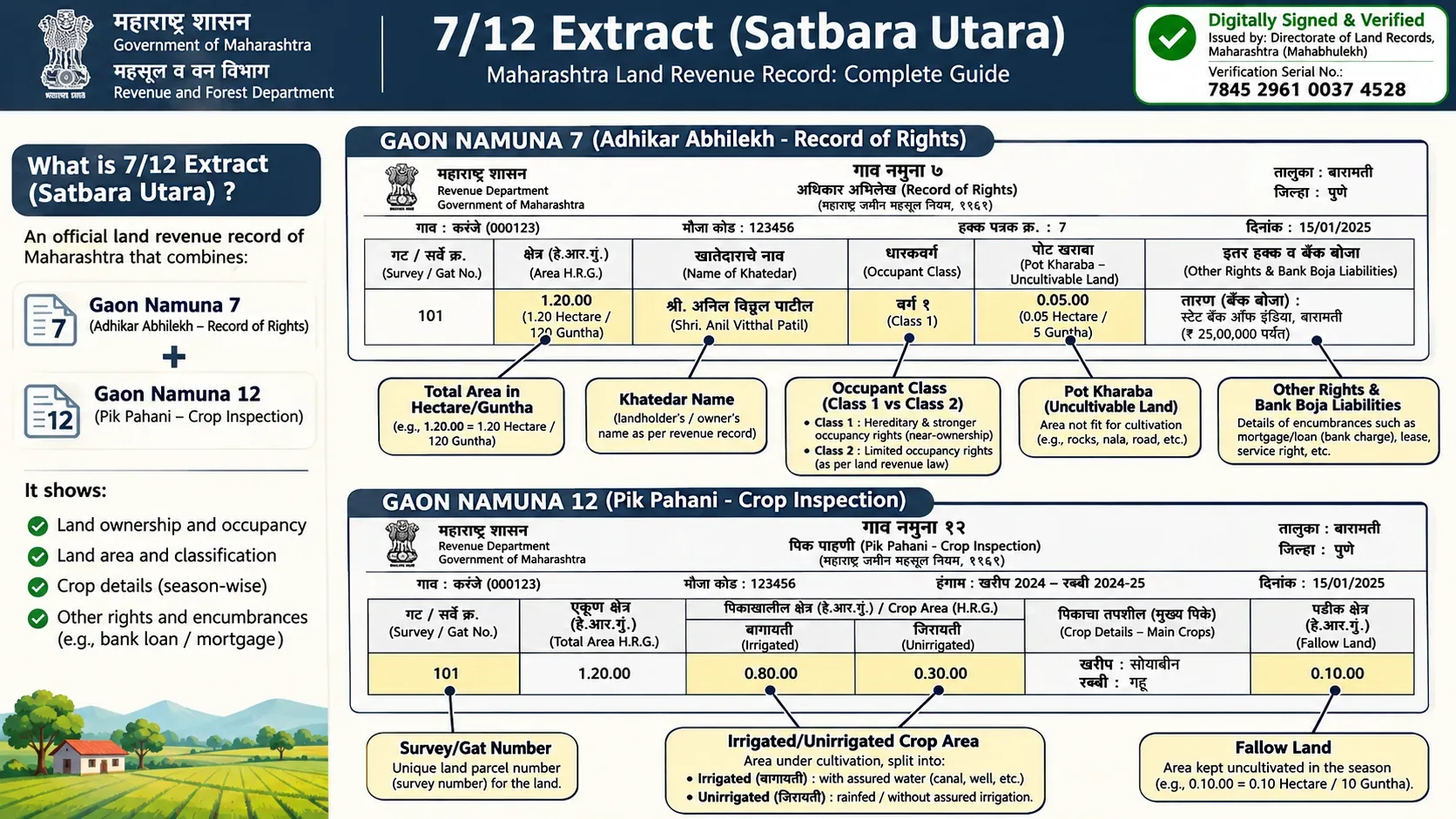
A Maharashtra 7/12 Extract (Satbara Utara) is an official land record prescribed under the Maharashtra Land Revenue Code, 1966. It combines Village Form 7 (ownership, tenure class, area, and encumbrances) with Village Form 12 (agricultural crops and irrigation). Maintained by the Talathi, it provides presumptive fiscal evidence of land rights across Maharashtra's 36 revenue districts.
Administrative Dimension Fact Sheet
| Administrative Dimension | Statutory Specification & Governance Standard |
|---|---|
| State Revenue Jurisdiction | State of Maharashtra (Revenue & Forest Department, Mantralaya, Mumbai) |
| Governing Land Code | Maharashtra Land Revenue Code, 1966 (MLRC 1966) & MLRC Record of Rights Rules, 1971 |
| Official Portals | Inspection: Mahabhulekh | Issuance: DigitalSatbara Portal |
| Record Forms Combined | Gaon Namuna 7 (Adhikar Abhilekh) + Gaon Namuna 12 (Pik Pahani Nondvahi) |
| Primary Field Custodian | Village Talathi (तलाठी / तलाठी सजा) under supervision of Circle Officer (मंडळ अधिकारी) |
| Statutory Fee Schedule | Free for online viewing on Mahabhulekh; Rs 15 per copy for certified digitally signed extract |
| 6 Administrative Divisions | Konkan, Pune, Nashik, Chhatrapati Sambhajinagar (Aurangabad), Amravati, and Nagpur |
| Evidentiary Admissibility | Presumptive evidence of possession and fiscal liability; not conclusive title under Supreme Court precedents |
| Citizen Grievance Helpline | State Land Records Helpline: 020-25712712 | Directorate: 020-26050006 (dlrmah.mah@nic.in) |
Statutory Dissection of Gaon Namuna 7 (Adhikar Abhilekh - Record of Rights)
Gaon Namuna 7 forms the upper half of the Satbara extract and constitutes the statutory record of rights and liabilities under Section 148 of the MLRC 1966. Every parcel entry contains eight critical legal particulars:
1. Revenue Village, Taluka, and District (गाव, तालुका, जिल्हा)
Identifies the geographical revenue jurisdiction. In Maharashtra, revenue villages (Mauje) maintain distinct cadastral numbers regardless of postal or municipal pin codes.
2. Survey Number / Gat Number and Sub-Division (सर्व्हे नंबर / गट नंबर व हिस्सा नंबर)
Represents the unique cadastral parcel identifier. Under the Bombay Prevention of Fragmentation and Consolidation of Holdings Act 1947, historical British-era Survey Numbers were consolidated into unified Gat Numbers across rural Maharashtra. If a parcel has undergone partition, it carries a fractional Hissa Number (e.g., Gat 214/1, 214/2).
3. Bhogwataadar Varg (Occupant Class / Tenure Category)
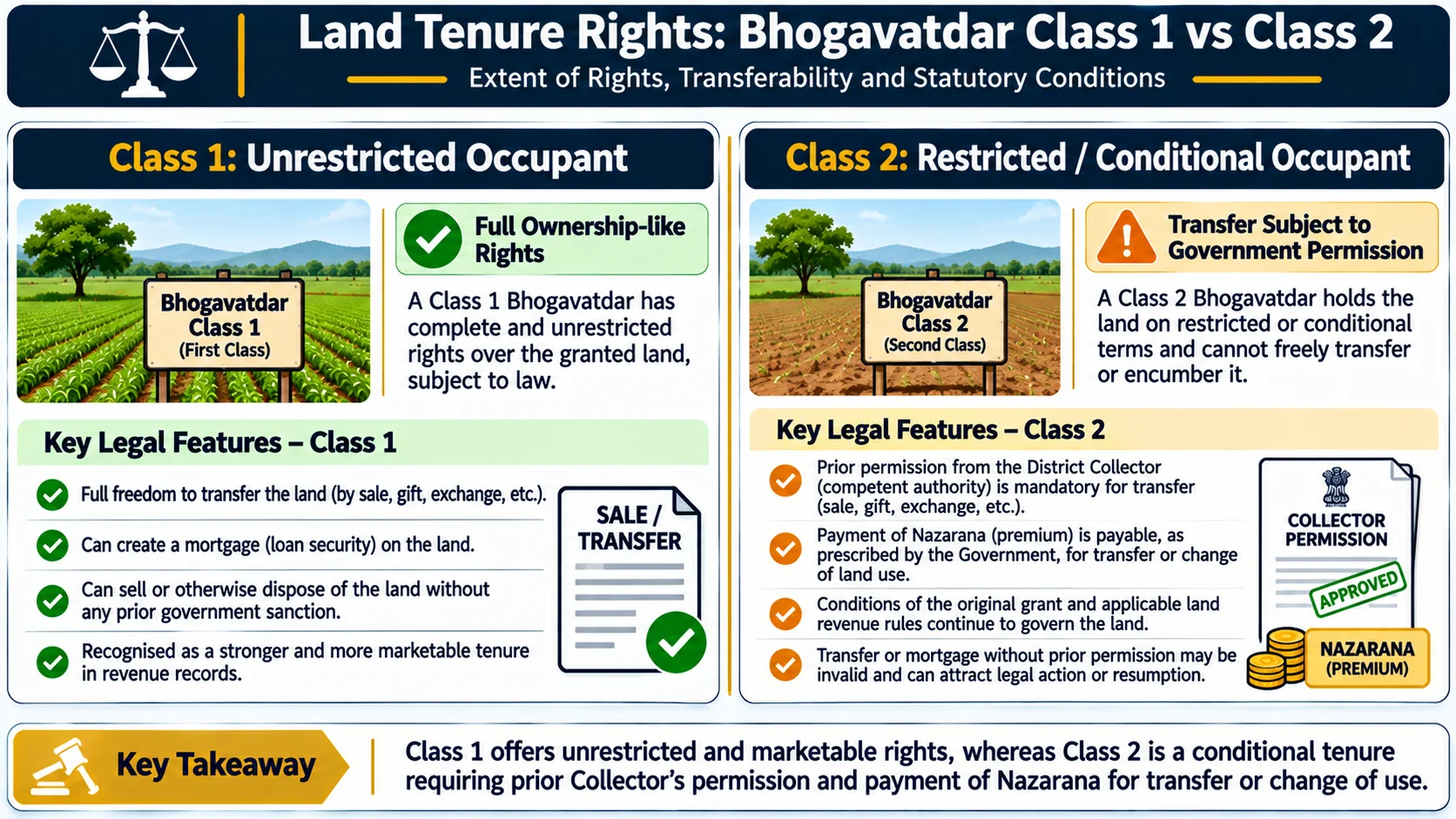
This is the most consequential legal entry on the extract, determining property transferability:
- Occupant Class 1 (भोगवटादार वर्ग १ - Khalsa / Freehold): Absolute ownership rights with unrestricted alienation. The holder may sell, partition, gift, or mortgage the land without prior government permission.
- Occupant Class 2 (भोगवटादार वर्ग २ - Restricted Tenure): Conditional or restricted ownership granted by the government (e.g., Inam lands, Mahar Watan, tribal allotments, or land granted under the Maharashtra Agricultural Lands Ceiling Act 1961). Class 2 land cannot be transferred, leased, sold, or mortgaged without prior written sanction from the District Collector and payment of state unearned income (Nazarana). Any unregistered transaction is void ab initio under Section 36A of the MLRC.
- Government Leasehold (सरकारी पट्टेदार): Land leased directly from state revenue authorities for a fixed term subject to lease rent and non-agricultural covenants.
4. Khatedar Name (खातेदाराचे नाव)
Lists the names of all registered holders and co-sharers. Each name is accompanied by a bracketed Mutation Number (फेरफार नंबर), cross-referencing the exact Village Form 6 transaction that created or altered that person's interest.
5. Total Area and Pot Kharaba (एकूण क्षेत्र व पोटखराबा)
Land area is measured in Hectares (हे.) and Ares (आर., where 1 Are = 1 Guntha = 1,089 sq ft). The total area is partitioned into:
- Cultivable Area (लागवडीयोग्य क्षेत्र): Area subject to agricultural assessment.
- Pot Kharaba Class A (पोटखराबा वर्ग अ): Land naturally unfit for cultivation due to physical characteristics (rocky outcroppings, steep ravines, nallas, or riverbeds). Deducted from tax assessment.
- Pot Kharaba Class B (पोटखराबा वर्ग ब): Land reserved for designated communal or public infrastructure (public roads, cart-tracks, percolation tanks, school paths, or irrigation canals). Class B land cannot be cultivated, altered, or encroached upon by the landowner.
6. Akar (Assessment Tax - आकार)
The annual land revenue tax assessed by the Settlement Commissioner and payable to the state government under Section 68 of MLRC 1966.
7. Itar Hakka (Other Rights and Encumbrances - इतर हक्क)
Records all statutory third-party rights and legal encumbrances:
- Bank Boja (बँक बोजा): Mortgage charges registered by cooperative or commercial banks against agricultural crop loans or term loans.
- Protected Tenants (संरक्षित कुळ): Tenancy rights protected under Section 32G or 32M of the Bombay Tenancy and Agricultural Lands Act 1948.
- Civil Court Injunctions / Attachments (न्यायालयीन जप्ती): Pending litigation notes or interim freeze orders issued by civil courts.
- Government Liens / Dues (शासकीय देणी): Outstanding irrigation cess, land revenue arrears, or recovery certificates issued by revenue authorities.
Statutory Dissection of Gaon Namuna 12 (Pik Pahani - Crop Inspection Register)
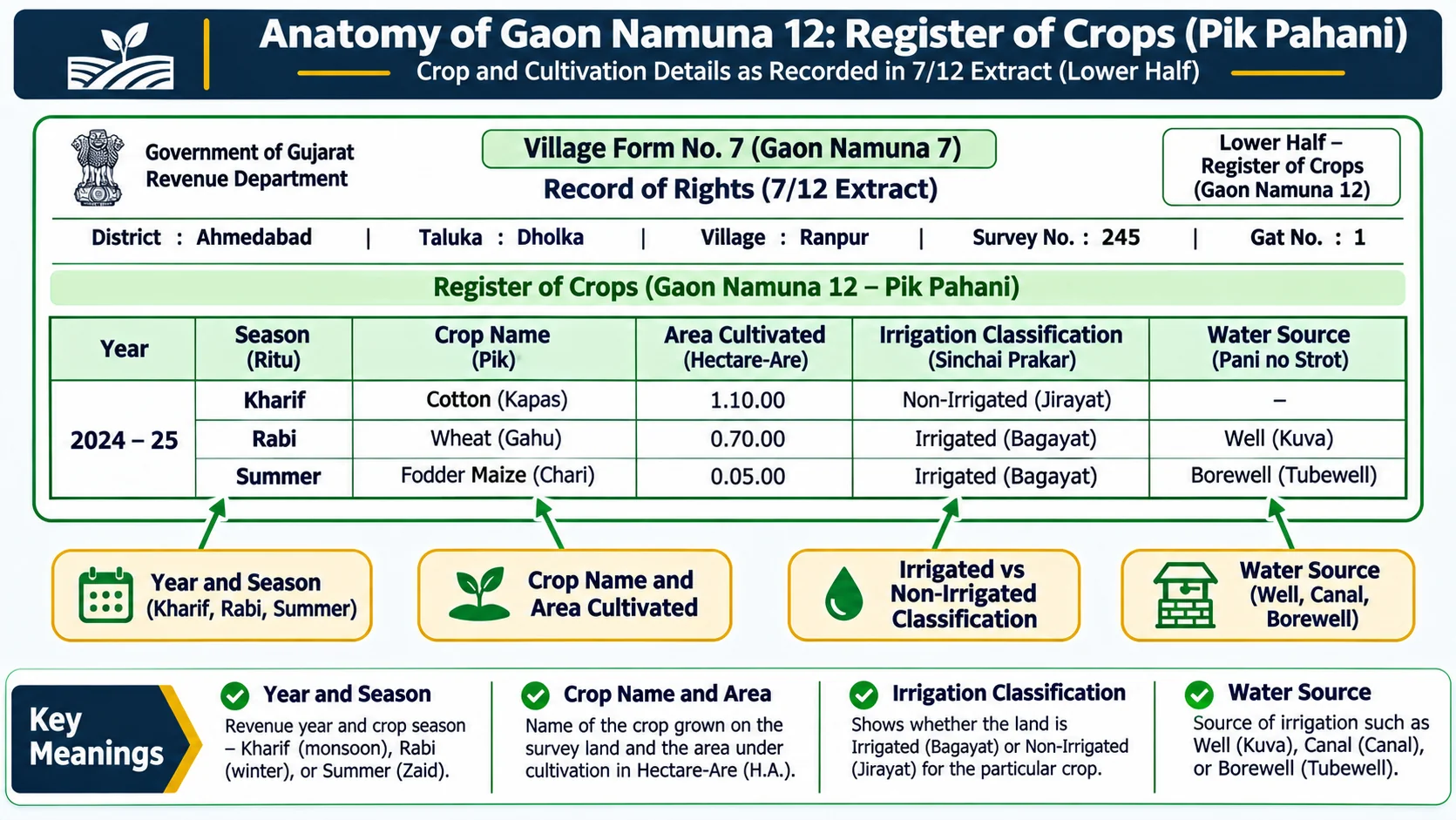
Gaon Namuna 12 forms the lower register of the extract and tracks seasonal agricultural operations under the Maharashtra Land Revenue (Inspection and Crop Register) Rules. Cultivation entries are recorded for three agricultural seasons: Kharif (पावसाळी पिके), Rabi (हिवाळी पिके), and Summer (उन्हाळी पिके).
Key Columns Recorded on Gaon Namuna 12
- Crop Name and Variety (पिकाचे नाव): Details primary cash crops (Sugarcane, Cotton, Soybean, Onion, Tur) and mixed crops.
- Cultivated Area (पिकाखालील क्षेत्र): Exact area in Hectares and Ares planted under that crop season.
- Irrigation Source (पाणी पुरवठ्याचे साधन): Specifies whether land is irrigated by Well (विहीर), Borewell (कूपनलिका), Lift Irrigation (उपसा जलसिंचन), Government Canal (पाटबंधारे), or relies on rainfall (जिरायत).
- Uncultivated Land (पडीक जमीन): Tracks fallow land (चालू पड or कायम पड) where no cultivation occurred during the agricultural year.
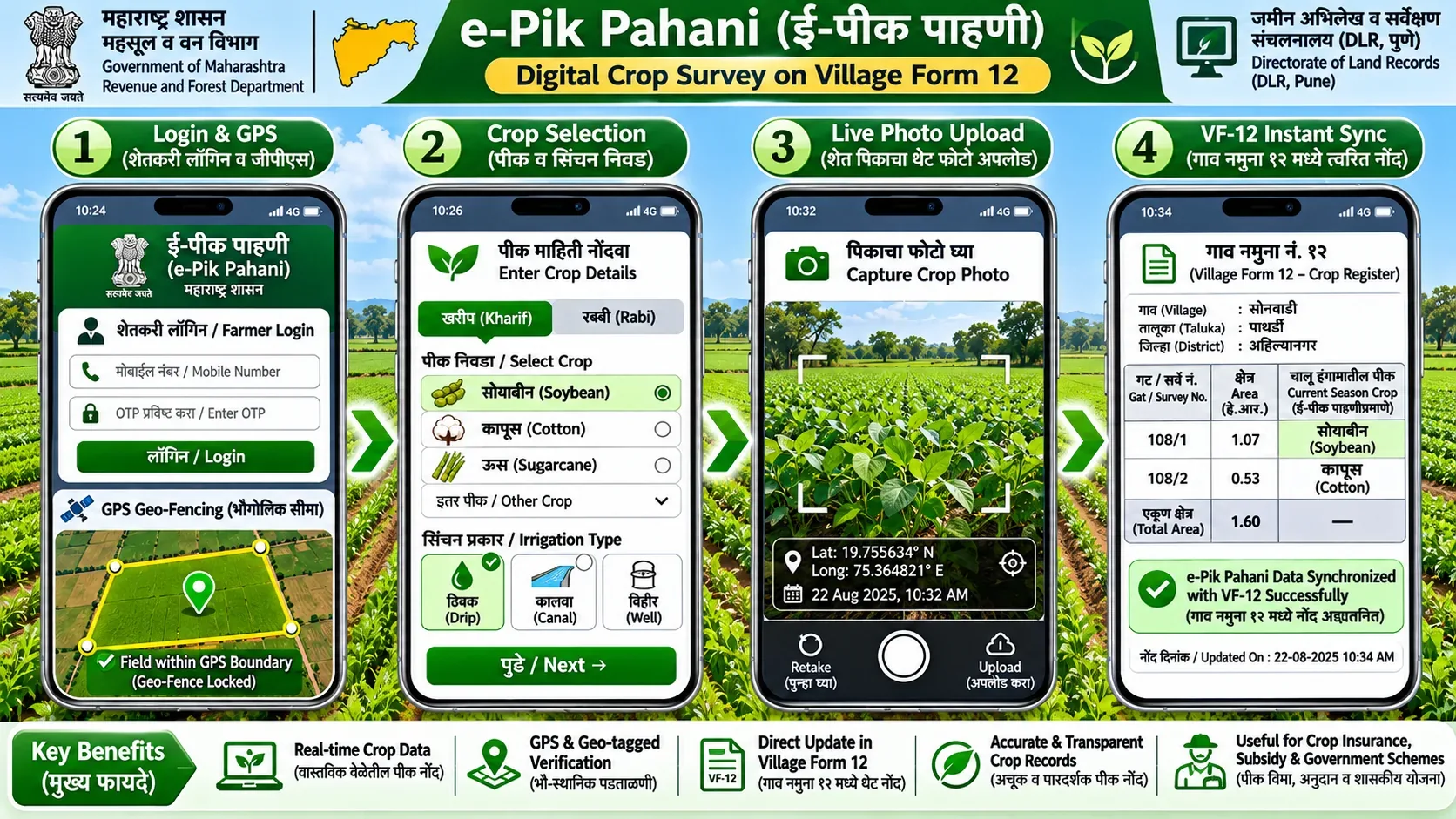
- Digital e-Pik Pahani Integration: Under state government digitization directives, farmers now record crop entries directly via the GPS-enabled e-Pik Pahani smartphone application. The uploaded geo-tagged photograph and satellite boundary lock directly populate Gaon Namuna 12, serving as verifiable proof for crop damage claims under the Pradhan Mantri Fasal Bima Yojana (PMFBY).
Comparative Matrix: 7/12, 8A, Ferfar, and Property Cards
Maharashtra revenue administration maintains several complementary statutory registers. Understanding their statutory boundaries prevents misinterpreting land records during property transactions:
| Document Type | Statutory Authority | Core Administrative Function | Primary Information Recorded | Portal Source |
|---|---|---|---|---|
| 7/12 Extract (सातबारा उतारा) | Gaon Namuna 7 + 12 (MLRC 1966) | Parcel-level land record of rights and seasonal crop cultivation | Holders, tenure class, area, Pot Kharaba, Boja encumbrances, and seasonal crops | Mahabhulekh / DigitalSatbara |
| 8A Extract (८अ नोंदवही) | Gaon Namuna 8A (Khate Pustika) | Individual landholder consolidated holding roll | List of all Survey/Gat parcels owned by a single Khatedar within the village, and tax liability | Mahabhulekh / DigitalSatbara |
| Ferfar (फेरफार - Form 6) | Gaon Namuna 6 (Register of Mutations) | Chronological record of ownership, inheritance, and encumbrance mutations | Sale deeds, partition orders, succession (Waris) entries, and mortgage charge creations | Aapli Chawadi / Mahabhulekh |
| Property Card (मालमत्ता पत्रक) | City Survey Record (CTS Card) | Urban title extract for designated municipal and gaothan non-agricultural plots | CTS Number, municipal plot area, local authority tenure, and urban title endorsements | Mahabhumi City Survey Portal |
Understanding Mutation (Ferfar) & Section 150 MLRC Objection Procedure
A 7/12 extract changes with every approved transaction recorded in Village Form 6 (Ferfar Patrak). When a land parcel undergoes a legal transaction, the Record of Rights cannot be altered directly by the Talathi without following statutory mutation procedure:
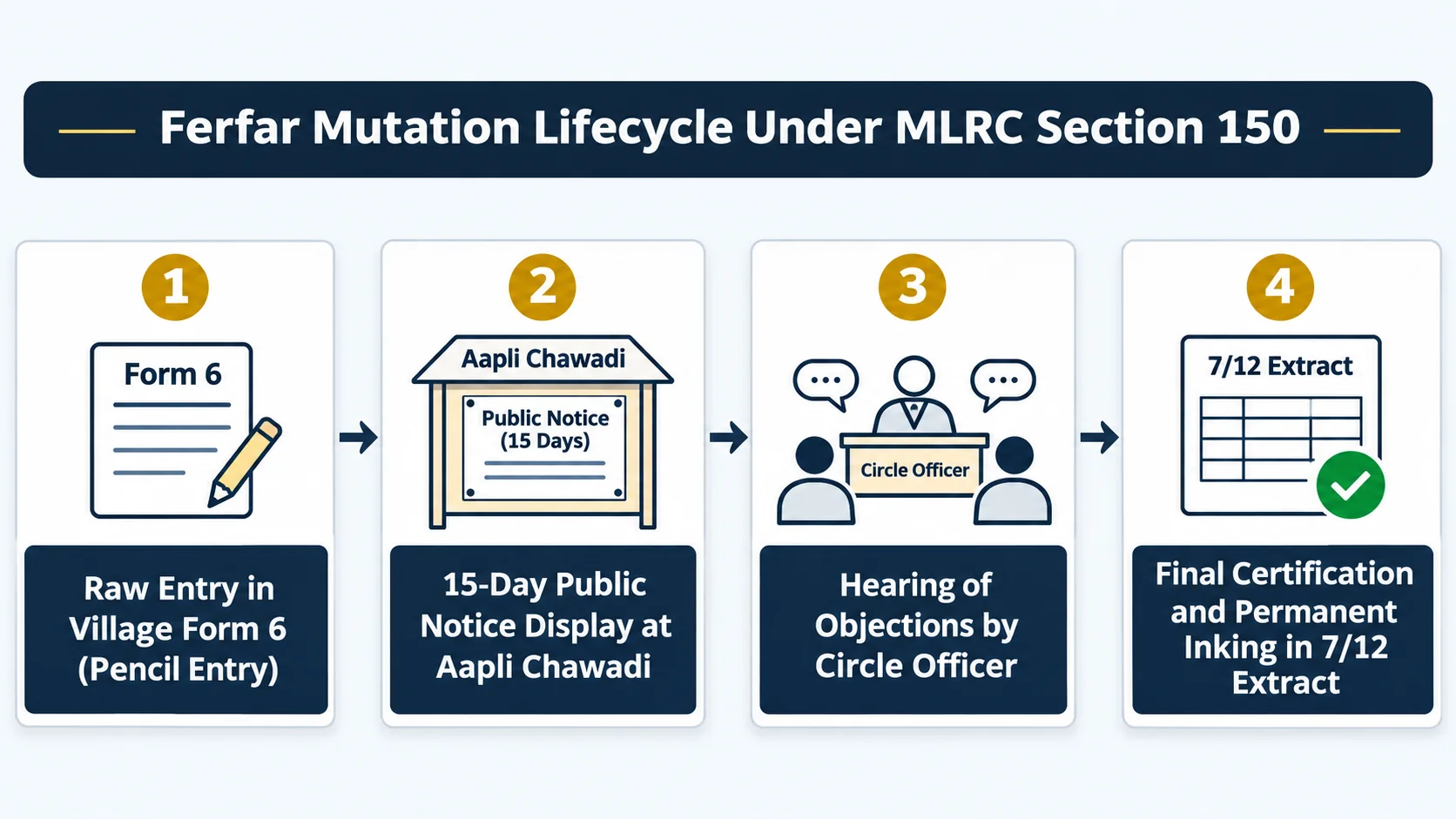
The 4-Stage Mutation Lifecycle under Section 150 MLRC
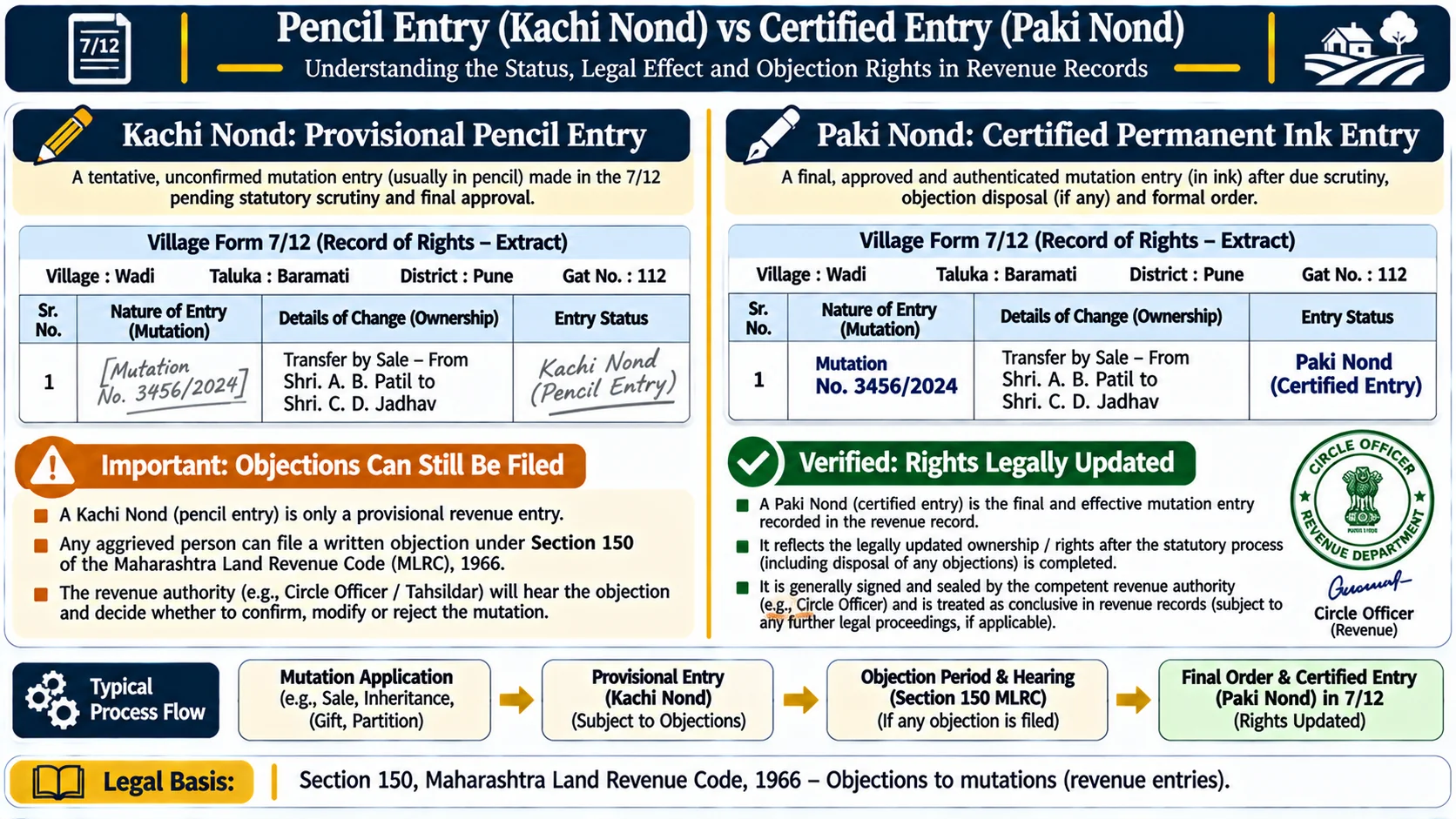
- Initiation (Kacchi Nond): An application is submitted via the e-Hakk portal or directly to the Talathi based on a registered sale deed, succession application, partition decree, or bank loan sanction. The Talathi enters a provisional pencil entry (कच्ची नोंद).
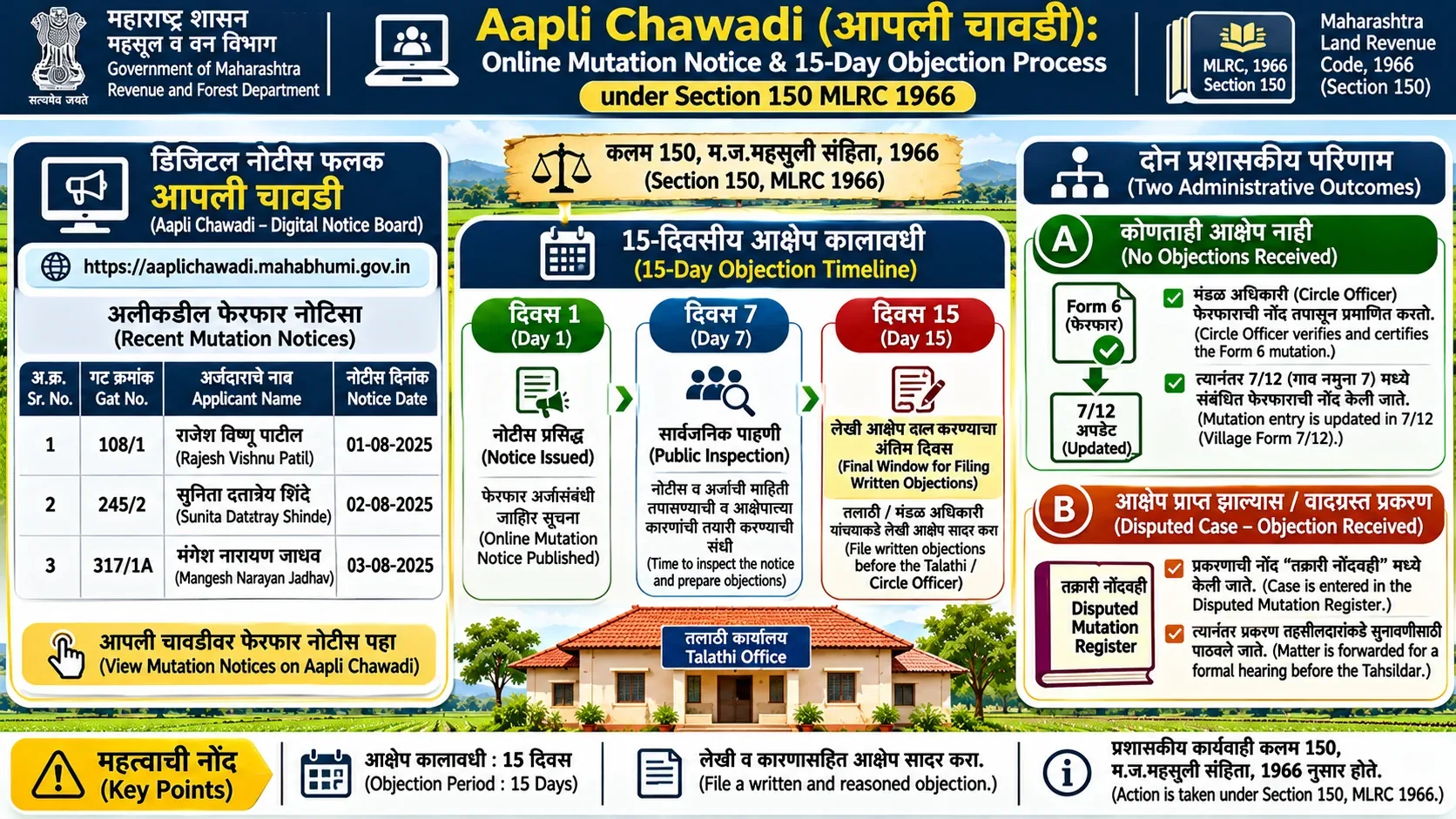
- Statutory Public Notice (Section 150 Notice): The Talathi issues notice to all interested parties and publishes the notice on the official digital notice board Aapli Chawadi for a mandatory period of 15 days.
- Objection Window: Any co-holder, family claimant, or affected party may submit written objections to the Talathi within the 15-day window.
- Certification (Pakkhi Nond):
- Uncontested Entries: If no objections are received within 15 days, the Circle Officer (मंडळ अधिकारी) examines the supporting title documents and certifies the mutation (नोंद मंजूर करणे). The entry becomes permanent (पक्की नोंद), and the 7/12 extract updates automatically.
- Contested Entries: If written objections are registered, the Talathi transfers the matter to the Disputed Cases Register (तक्रारी नोंदवही). The Tahsildar conducts a formal quasi-judicial hearing, examines evidence under the MLRC, and passes a speaking order approving or rejecting the mutation.
Judicial Evidentiary Standing: Why a 7/12 Does Not Establish Conclusive Title
Citizens and property purchasers frequently assume that a registered name on a 7/12 extract is conclusive proof of land ownership. In Indian jurisprudence, this assumption is legally erroneous.
1. Suraj Bhan & Ors. v. Financial Commissioner (2007) 6 SCC 186: The Supreme Court held that revenue entries and mutation orders are maintained exclusively for fiscal administration and assessment collection. Revenue records do not confer, extinguish, or determine substantive ownership rights to immovable property.
2. Bhimabai Mahadeo Kambekar v. Arthur Import & Export Co. (2019) 3 SCC 191: The Supreme Court reiterated that mutation entries in a 7/12 extract establish a rebuttable presumption of physical possession for land tax purposes, but do not create title. Real estate title can only be created and proved through valid registered deeds under the Registration Act 1908 and Transfer of Property Act 1882.
Before buying agricultural land, inspect registered deed volumes at the Sub-Registrar office for the preceding 30 years, verify mutation history on Village Form 6, and apply our Buyer 7-Point Land Due Diligence Checklist to prevent title disputes.
Frequently Asked Questions on Maharashtra Land Records
What is the difference between Village Form 7 and Village Form 12?
Village Form 7 (Adhikar Abhilekh) records ownership rights, occupant classification (Class 1 or Class 2), total land area, assessment tax (Akar), and financial encumbrances (Bank Boja). Village Form 12 (Pik Pahani) records seasonal agricultural cultivation, crop varieties, irrigation methods, and uncultivated fallow land.
What does Occupant Class 2 (Bhogwataadar Varg 2) mean on a Maharashtra 7/12?
Bhogavatdar Class 2 land carries statutory restrictions on transfer, including Inam grants, tribal holdings, and agricultural ceiling allotments. Unlike Class 1 freehold land, Class 2 land cannot be sold, gifted, leased, or mortgaged without prior written sanction from the District Collector and payment of prescribed government unearned income (Nazarana).
What is the difference between Pot Kharaba Class A and Class B?
Pot Kharaba denotes uncultivable land deducted from revenue assessment. Class A comprises uncultivable land due to natural topography (such as rocky patches, ravines, and nallas). Class B comprises land reserved for public or communal purposes (such as public pathways, roads, irrigation canals, and drinking water sources); Class B land cannot be brought under cultivation or encroached upon.
Is a 7/12 extract conclusive proof of property ownership in civil court?
No. Under established Supreme Court jurisprudence (Suraj Bhan v. Financial Commissioner and Bhimabai Mahadeo Kambekar v. Arthur Import & Export Co.), a 7/12 extract is a fiscal revenue record maintained for tax administration and presumptive possession. It does not create or extinguish substantive legal title, which must be proved through registered conveyances.
How does e-Pik Pahani update Village Form 12 on the 7/12 extract?
e-Pik Pahani is the official Government of Maharashtra mobile application enabling farmers to self-report seasonal crop patterns directly from their fields. The application locks GPS boundary coordinates, timestamps a live crop photograph, and transmits the verified data directly to the land records server, updating Gaon Namuna 12 without manual Talathi intervention.
What is the 15-day objection window for Form 6 Ferfar on Aapli Chawadi?
Under Section 150 of the Maharashtra Land Revenue Code 1966, when a mutation notice is generated, it is published on the digital notice board Aapli Chawadi for 15 days. Interested parties or co-holders may file written objections with the Talathi during this window. If objections are received, the entry is transferred to the Disputed Cases Register for hearing before the Tahsildar.
Official Statutory References & State Portals
- Mahabhulekh Official Portal: Official viewing desk for uncertified 7/12 and 8A extracts across 6 administrative divisions.
- DigitalSatbara Official Portal: Government portal for certified digitally signed extracts under IT Act Section 5.
- Aapli Chawadi Official Portal: Public digital notice board for tracking 15-day Section 150 mutation notices.
- Maharashtra Land Records Department: Official repository of land codes, circulars, and departmental orders.
- Digital India Land Records Modernization Programme (DILRMP): National portal under the Ministry of Rural Development.
Related Procedural Guides: Download Digitally Signed 7/12 | Remove Bank Loan Boja from 7/12 | Search 7/12 by Survey / Gat Number | 7/12 Extract vs Urban Property Card.